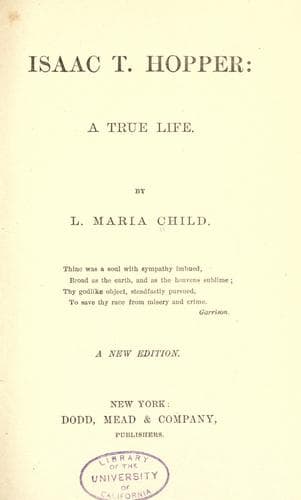
Fugitive slaves -- United States; Hopper, Isaac T. (Isaac Tatem), 1771-1852
After a long time spent in affectionate entreaty, she leaned her young
head on his friendly shoulder, and sobbed out, "Oh, I wish I was dead.
What will my poor mother say when she knows of my disgrace?"
"Perhaps we can manage that she never shall know it," replied he.
Alluring her by this hope, he gradually obtained from her the whole
story of her acquaintance with the nobleman. He bade her be comforted,
and take nourishment; for he would see that the silk was paid for, and
the prosecution withdrawn.
He went immediately to her employer, and told him the story. "This is
her first offence," said he. "The girl is young, and she is the only
child of a poor widow. Give her a chance to retrieve this one false
step, and she may be restored to society, a useful and honored woman. I
will see that thou art paid for the silk." The man readily agreed to
withdraw the prosecution, and said he would have dealt otherwise by the
girl, if he had known all the circumstances. "Thou shouldst have
inquired into the merits of the case," replied Friend Hopper. "By this
kind of thoughtlessness, many a young creature is driven into the
downward path, who might easily have been saved."
The kind-hearted man next proceeded to the hotel, and with Quaker
simplicity of speech inquired for Henry Stuart. The servant said his
lordship had not yet risen. "Tell him my business is of importance,"
said Friend Hopper. The servant soon returned and conducted him to the
chamber. The nobleman appeared surprised that a stranger, in the plain
Quaker costume, should thus intrude upon his luxurious privacy. When he
heard his errand, he blushed deeply, and frankly admitted the truth of
the girl's statement. His benevolent visitor took the opportunity to
"bear a testimony" against the selfishness and sin of profligacy. He did
it in such a kind and fatherly manner, that the young man's heart was
touched. He excused himself, by saying that he would not have tampered
with the girl, if he had known her to be virtuous. "I have done many
wrong things," said he, "but thank God, no betrayal of confiding
innocence weighs on my conscience. I have always esteemed it the basest
act of which man is capable." The imprisonment of the poor girl, and the
forlorn situation in which she had been found, distressed him greatly.
When Friend Hopper represented that the silk had been stolen for _his_
sake, that the girl had thereby lost profitable employment, and was
obliged to return to her distant home, to avoid the danger of exposure,
he took out a fifty dollar note, and offered it to pay her expenses.
"Nay," said Isaac. "Thou art a very rich man, I presume. I see in thy
hand a large roll of such notes. She is the daughter of a poor widow,
and thou hast been the means of doing her great injury. Give me
another."
Public-domain text, read in full here on John Shaqi.
Reviews
Reviews
No reviews yet
Be the first to share your thoughts on this work.
Elsewhere in the archive
Join the Discussion
Join the discussion
Sign in to leave a comment or review.
Sign InorCreate an account