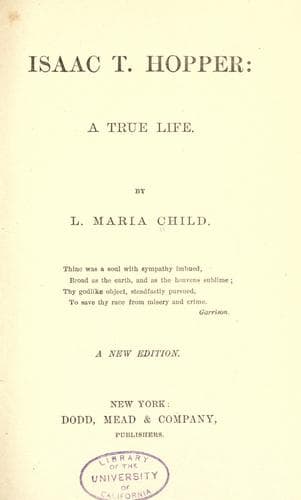
Fugitive slaves -- United States; Hopper, Isaac T. (Isaac Tatem), 1771-1852
Lord Henry handed him another fifty dollar note, and smiled as he said,
"You understand your business well. But you have acted nobly, and I
reverence you for it. If you ever visit England, come to see me. I will
give you a cordial welcome, and treat you like a nobleman."
"Farewell, friend," replied the Quaker. "Though much to blame in this
affair, thou too hast behaved nobly. Mayst thou be blessed in domestic
life, and trifle no more with the feelings of poor girls; not even with
those whom others have betrayed and deserted."
When the girl was arrested, she had sufficient presence of mind to
assume a false name, and by that means, her true name had been kept out
of the newspapers. "I did this," said she, "for my poor mother's sake."
With the money given by Lord Stuart, the silk was paid for, and she was
sent home to her mother well provided with clothing. Her name and place
of residence forever remained a secret in the breast of her benefactor.
Years after these events transpired, a lady called at Friend Hopper's
house, and asked to see him. When he entered the room, he found a
handsomely dressed young matron, with a blooming boy of five or six
years old. She rose quickly to meet him, and her voice choked as she
said, "Friend Hopper, do you know me?" He replied that he did not. She
fixed her tearful eyes earnestly upon him, and said, "You once helped me
when in great distress." But the good missionary of humanity had helped
too many in distress, to be able to recollect her without more precise
information. With a tremulous voice, she bade her son go into the next
room for a few minutes; then dropping on her knees, she hid her face in
his lap, and sobbed out, "I am the girl who stole the silk. Oh, where
should I now be, if it had not been for you!"
When her emotion was somewhat calmed, she told him that she had married
a highly respectable man, a senator of his native state. Being on a
visit in Friend Hopper's vicinity, she had again and again passed his
dwelling, looking wistfully at the windows to catch a sight of him; but
when she attempted to enter her courage failed.
"But I must return home to-morrow," said she, "and I could not go away
without once more seeing and thanking him who saved me from ruin." She
recalled her little boy, and said to him, "Look at that gentleman, and
remember him well; for he was the best friend your mother ever had."
With an earnest invitation to visit her happy home, and a fervent "God
bless you!" she bade her benefactor farewell.
THE TWO YOUNG OFFENDERS.
Public-domain text, read in full here on John Shaqi.
Reviews
Reviews
No reviews yet
Be the first to share your thoughts on this work.
Elsewhere in the archive
Join the Discussion
Join the discussion
Sign in to leave a comment or review.
Sign InorCreate an account