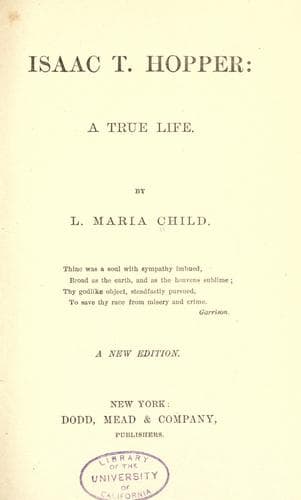
Fugitive slaves -- United States; Hopper, Isaac T. (Isaac Tatem), 1771-1852
He then proceeded to relate the particulars of the interview; to which
the clergyman listened with evident astonishment. When the communication
was finished, he said, "I don't know who this man is, or how he has
obtained information on this subject; but certain it is, he has
repeated, word for word, a conversation which I supposed was known only
to myself and the deceased."
The woman in question had gone out in the fields one day, with her
infant in her arms, and she returned without it. She said she had laid
it down on a heap of dry leaves, while she went to pick a few flowers;
and when she returned, the baby was gone. The fields and woods were
searched in vain, and neighbors began to whisper that she had committed
infanticide. Then rumors arose that she was dissatisfied with her
marriage; that her heart remained with a young man to whom she was
previously engaged; and that her brain was affected by this secret
unhappiness. She was never publicly accused; partly because there was no
evidence against her, and partly because it was supposed that if she did
commit the crime, it must have been owing to aberration of mind. But she
became aware of the whisperings against her, and the consciousness of
being an object of suspicion, combined with the mysterious disappearance
of her child, cast a heavy cloud over her life, and made her appear more
and more unlike her former self. This she confided to her clergyman, in
the interview shortly preceding her death; and she likewise told him
that the young man, to whom she had been engaged, had never forgiven her
for not marrying him.
A few weeks after her decease, this young man confessed that he had
stolen the babe. He had followed the mother, unobserved by her, and had
seen her lay the sleeping infant on its bed of leaves. As he gazed upon
it, a mingled feeling of jealousy and revenge took possession of his
soul. In obedience to a sudden impulse, he seized the babe, and carried
it off hastily. He subsequently conveyed it to a distant village, and
placed it out to nurse, under an assumed name and history. The child was
found alive and well, at the place he indicated. Thus the mother's
innocence was made clearly manifest to the world, as the Quaker
preacher had predicted at her funeral.
I often heard Friend Hopper relate this anecdote, and he always said
that he could vouch for the truth of it; and for several other similar
things in connection with the ministry of his friend Arthur.
A singular case of inward perception likewise occurred in the experience
of his own mother. In her Diary, which is still preserved in the family,
she describes a visit to some of her children in Philadelphia, and adds:
"Soon after this, the Lord showed me that I should lose a son. It was
often told me, though without sound of words. Nothing could be more
intelligible than this still, small voice. It said, Thou wilt lose a
son; and he is a pleasant child."
Public-domain text, read in full here on John Shaqi.
Reviews
Reviews
No reviews yet
Be the first to share your thoughts on this work.
Elsewhere in the archive
Join the Discussion
Join the discussion
Sign in to leave a comment or review.
Sign InorCreate an account