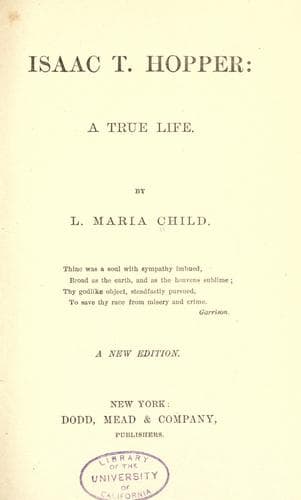
Fugitive slaves -- United States; Hopper, Isaac T. (Isaac Tatem), 1771-1852
Her son James resided with relatives in Philadelphia, and often went to
bathe in the Delaware. On one of these occasions, soon after his
mother's visit, a friend who went with him sank in the water, and James
lost his own life by efforts to save him. A messenger was sent to inform
his parents, who lived at the distance of eight miles. While he staid in
the house, reluctant to do his mournful errand, the mother was seized
with sudden dread, and heard the inward voice saying, "James is
drowned." She said abruptly to the messenger, "Thou hast come to tell me
that my son James is drowned. Oh, how did it happen?" He was much
surprised, and asked why she thought so. She could give no explanation
of it, except that it had been suddenly revealed to her mind.
I have heard and read many such stories of Quakers, which seem too well
authenticated to admit of doubt. They themselves refer all such cases to
"the inward light;" and that phrase, as they understand it, conveys a
satisfactory explanation to their minds. I leave psychologists to settle
the question as they can.
Those who are well acquainted with Quaker views, are aware that by "the
inward light," they signify something higher and more comprehensive than
conscience. They regard it as the voice of God in the soul, which will
always guard man from evil, and guide him into truth, if reverently
listened to, in stillness of the passions, and obedience of the will.
These strong impressions on individual minds constitute their only call
and consecration to the ministry, and have directed' them in the
application of moral principles to a variety of subjects, such as
intemperance, war, and slavery. Men and women were impelled by the
interior monitor to go about preaching on these topics, until their
individual views became what are called "leading testimonies" in the
Society. The abjuration of slavery was one of their earliest
"testimonies." There was much preaching against it in their public
meetings, and many committees were appointed to expostulate in private
with those who held slaves. At an early period, it became an established
rule of discipline for the Society to disown any member, who refused to
manumit his bondmen.
Public-domain text, read in full here on John Shaqi.
Reviews
Reviews
No reviews yet
Be the first to share your thoughts on this work.
Elsewhere in the archive
Join the Discussion
Join the discussion
Sign in to leave a comment or review.
Sign InorCreate an account