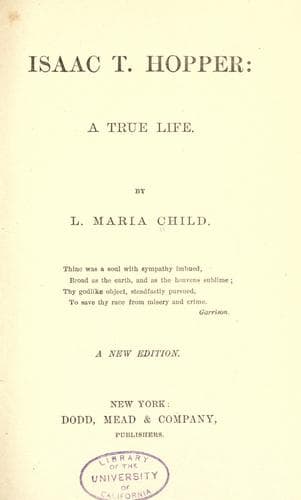
Fugitive slaves -- United States; Hopper, Isaac T. (Isaac Tatem), 1771-1852
Friend Hopper used to mention a case where a strong impression had been
made on his own mind, without his being able to assign any adequate
reason for it. A young man, descended from a highly respectable Quaker
family in New-Jersey, went to South Carolina and entered into business.
He married there, and as his wife did not belong to the Society of
Friends, he was of course disowned. After some years of commercial
success, he failed, and went to Philadelphia, where Friend Hopper became
acquainted with him, and formed an opinion not unfavorable. When he had
been in that city some time, he mentioned that his wife owned land in
Carolina, which he was very desirous to cultivate, but was prevented by
conscientious scruples concerning slave-labor. He said if he could
induce some colored people from Philadelphia to go there and work for
him as free laborers, it would be an advantage to him, and a benefit to
them. He urged Friend Hopper to exert his influence over them to
convince them that such precautions could be taken, as would prevent any
danger of their being reduced to slavery; saying that if he would
consent to do so, he doubtless could obtain as many laborers as he
wanted. The plan appeared feasible, and Friend Hopper was inclined to
assist him in carrying it into execution. Soon after, two colored men
called upon him, and said they were ready to go, provided he thought
well of the project. Nothing had occurred to change his opinion of the
man, or to excite distrust concerning his agricultural scheme. But an
impression came upon his mind that the laborers had better not go; an
impression so strong, that he thought it right to be influenced by it.
He accordingly told them he had thought well of the plan, but his views
had changed, and he advised them to remain where they were. This greatly
surprised the man who wished to employ them, and he called to
expostulate on the subject; repeating his statement concerning the great
advantage they would derive from entering into his service.
"There is no use in arguing the matter," replied Friend Hopper. "I have
no cause whatever to suspect thee of any dishonest or dishonorable
intentions; but there is on my mind an impression of danger, so powerful
that I cannot conscientiously have any agency in inducing colored
laborers to go with thee."
Public-domain text, read in full here on John Shaqi.
Reviews
Reviews
No reviews yet
Be the first to share your thoughts on this work.
Elsewhere in the archive
Join the Discussion
Join the discussion
Sign in to leave a comment or review.
Sign InorCreate an account