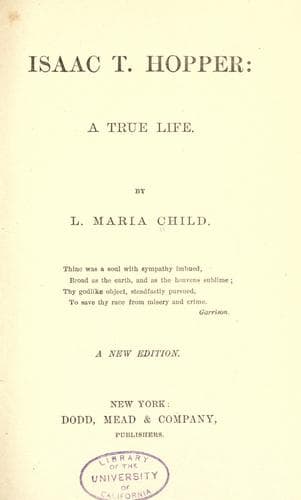
Fugitive slaves -- United States; Hopper, Isaac T. (Isaac Tatem), 1771-1852
Friend Hopper used to tell an interesting anecdote in connection with
these committees. In the course of their visits, they concluded to pass
by one of their members, who held only one slave, and he was very old.
He was too infirm to earn his own living, and as he was very kindly
treated, they supposed he would have no wish for freedom. But Isaac
Jackson, one of the committee, a very benevolent and conscientious man,
had a strong impression on his mind that duty required him not to omit
this case. He accordingly went alone to the master, and stated how the
subject appeared to him, in the inward light of his own soul. The Friend
was not easily convinced. He brought forward many reasons for not
emancipating his slave; and one of the strongest was that the man was
too feeble to labor for his own support, and therefore freedom would be
of no value to him. Isaac Jackson replied, "He labored for thee without
wages, while he had strength, and it is thy duty to support him now.
Whether he would value freedom or not, is a question he alone is
competent to decide."
These friendly remonstrances produced such effect, that the master
agreed to manumit his bondman, and give a written obligation that he
should be comfortably supported during the remainder of his life, by him
or his heirs. When the papers were prepared the slave was called into
the parlor, and Isaac Jackson inquired, "Would'st thou like to be free?"
He promptly answered that he should. The Friend suggested that he was
now too feeble to labor much, and inquired how he would manage to obtain
a living. The old man meekly replied, "Providence has been kind to me
thus far; and I am willing to trust him the rest of my life."
Isaac Jackson then held up the papers and said, "Thou art a free man.
Thy master has manumitted thee, and promised to maintain thee as long as
thou mayest live."
This was so unexpected, that the aged bondman was completely overcome.
For a few moments, he remained in profound silence; then, with a sudden
impulse, he fell on his knees, and poured forth a short and fervent
prayer of thanksgiving to his Heavenly Father, for prolonging his life
till he had the happiness to feel himself a free man.
The master and his adviser were both surprised and affected by this
eloquent outburst of grateful feeling. The poor old servant had seemed
so comfortable and contented, that no one supposed freedom was of great
importance to him. But, as honest Isaac Jackson observed, _he_ alone was
competent to decide _that_ question.
Quakers consider "the inward light" as a guide not merely in cases
involving moral principles, but also in the regulation of external
affairs; and in the annals of their Society, are some remarkable
instances of dangers avoided by the help of this internal monitor.
Public-domain text, read in full here on John Shaqi.
Reviews
Reviews
No reviews yet
Be the first to share your thoughts on this work.
Elsewhere in the archive
Join the Discussion
Join the discussion
Sign in to leave a comment or review.
Sign InorCreate an account