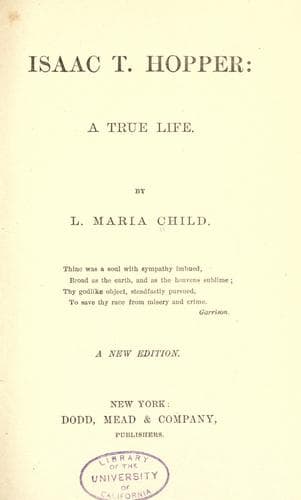
Fugitive slaves -- United States; Hopper, Isaac T. (Isaac Tatem), 1771-1852
That this description was remarkably accurate in most particulars will
be obvious to those who have read the preceding anecdotes. It is not
true, however, that he was enthusiastic in character, or that he had the
appearance of being so. He was far too practical and self-possessed, to
have the reputation of being "half crazy," even among those who are
prone to regard everything as insane that is out of the common course.
Neither do I think he was accustomed to "let himself down too much;" for
according to my radical ideas, a man _cannot_ "let himself down," who
"associates only with those whose moral characters are unimpeachable."
It is true that he was pleasant and playful in conversation with all
classes of people; but he was remarkably free from any tinge of
vulgarity. It is true, also, that he was totally and entirely
unconscious of any such thing as distinctions of rank. I have been
acquainted with many theoretical democrats, and with not a few who tried
to be democratic, from kind feelings-and principles of justice; but
Friend Hopper and Francis Jackson of Boston are the only two men I ever
met, who were born democrats; who could not help it, if they tried; and
who would not know _how_ to try; so completely did they, by nature,
ignore all artificial distinctions. Of course, I do not use the word
democrat in its limited party sense, but to express their perfect
unconsciousness that any man was considered to be above them, or any man
beneath them. If Friend Hopper encountered his wood-sawyer, after a
considerable absence, he would shake hands warmly, and give him a
cordial welcome. If the English Prince had called upon him, he would
have met with the same friendly reception, and would probably have been
accosted something after this fashion: "How art thou, friend Albert?
They tell me thou art amiable and kindly disposed toward the people; and
I am glad to see thee." Those who observe the parting advice given by
Isaac's mother, when he went to serve his apprenticeship in
Philadelphia, will easily infer that this peculiarity was hereditary.
Some men, who rise above their original position, either in character or
fortune, endeavor to conceal their early history. Others obtrude it upon
all occasions, in order to magnify themselves by a contrast between what
they have been and what they are. But he did neither the one nor the
other. The subject did not occupy his thoughts. He spoke of having been
a tailor, whenever it came naturally in his way, but never for the sake
of doing so. His having been born in a hen-house was a mere external
accident in his eyes; and in the same light he regarded the fact that
Victoria was born in a palace. What was the spiritual condition of the
two at any given age, was the only thing that seemed to him of real
importance.
Public-domain text, read in full here on John Shaqi.
Reviews
Reviews
No reviews yet
Be the first to share your thoughts on this work.
Elsewhere in the archive
Join the Discussion
Join the discussion
Sign in to leave a comment or review.
Sign InorCreate an account