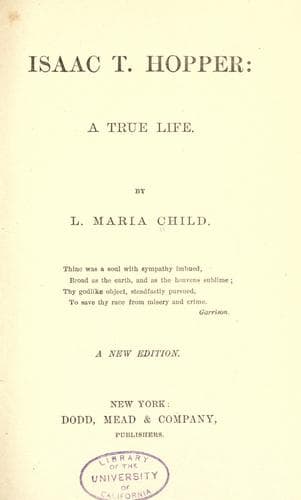
Fugitive slaves -- United States; Hopper, Isaac T. (Isaac Tatem), 1771-1852
His steadfastness in maintaining moral principles, "however unpopular
those principles might be," was severely tried in the autumn of 1838. At
a late hour in the night, two colored men came to his house, and one
introduced the other as a stranger in the city, who had need of a
lodging. Friend Hopper of course conjectured that he might be a fugitive
slave; and this conjecture was confirmed the next morning. The stranger
was a mulatto, about twenty-two years old, and called himself Thomas
Hughes. According to his own account, he was the son of a wealthy
planter in Virginia, who sold his mother with himself and his twin
sister when they were eleven months old. His mother and sister were
subsequently sold, but he could never ascertain where they were sent.
When he was about thirteen, he was purchased by the son of his first
master. Being hardly dealt with by this relative, he one day
remonstrated with him for treating his own brother with so much
severity. This was, of course, deemed a great piece of insolence in a
bondman, and he was punished by being sold to a speculator, carried off
hand-cuffed, with his feet tied under the horse's belly, and finally
shipped for Louisiana with a coffle of five hundred slaves. He was
bought by a gambler, who took him to Louisville, Kentucky. When he had
lived there three years, his master, having lost large sums of money,
told him he should be obliged to sell him. Thomas had meanwhile
ascertained that his father had removed to Kentucky, and was still a
very wealthy man. He obtained permission to go and see him, with the
hope that he would purchase him and set him free. Accordingly, he
called upon him, and told him that he was Thomas, the son of his slave
Rachel, who had always assured him that he was his father. The rich
planter did not deny poor Rachel's assertion, but in answer to her son's
inquiries, he plainly manifested that he neither knew nor cared who had
bought her, or to what part of the country she had been sent. Thomas
represented his own miserable condition, in being sold from one to
another, and subject to the will of whoever happened to be his owner. He
intreated his father to purchase him, with a view to manumission; but
himself and his proposition were both treated with supreme contempt.
Thus rejected by his father, and unable to discover any traces of his
mother, he returned disheartened to Louisville, and was soon after sent
to New-Orleans to be sold. Mr. John P. Darg, a speculator in slaves,
bought him; and he soon after married a girl named Mary, who belonged to
his new master. Mr. Darg went to New-York, to visit some relatives, and
took Thomas with him. It was only a few days after their arrival in the
city, that the slave left him, and went to Isaac T. Hopper to ask a
lodging. When he acknowledged that he was a fugitive, intending to take
refuge in Canada, it was deemed imprudent for him to remain under the
roof of a person so widely known as an abolitionist; but a very
Public-domain text, read in full here on John Shaqi.
Reviews
Reviews
No reviews yet
Be the first to share your thoughts on this work.
Elsewhere in the archive
Join the Discussion
Join the discussion
Sign in to leave a comment or review.
Sign InorCreate an account