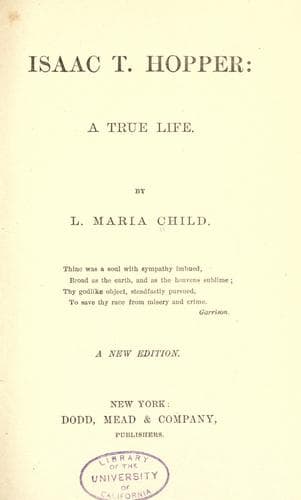
Fugitive slaves -- United States; Hopper, Isaac T. (Isaac Tatem), 1771-1852
benevolent and intelligent Quaker lady, near eighty years old, named
Margaret Shoemaker, gladly gave him shelter.
When Friend Hopper went to his place of business, after parting with the
colored stranger, he saw an advertisement in a newspaper called the Sun,
offering one thousand dollars reward for the apprehension and return of
a mulatto man, who had stolen seven or eight thousand dollars from a
house in Varick-street. A proportionate reward was offered for the
recovery of any part of the money. Though no names were mentioned, he
had reason to conjecture that Thomas Hughes might be the mulatto in
question. He accordingly sought him out, read the advertisement to him,
and inquired whether he had stolen anything from his master. He denied
having committed any theft, and said the pretence that he had done so
was a mere trick, often resorted to by slaveholders, when they wanted to
catch a runaway slave. That this remark was true, Friend Hopper knew
very well by his own experience; he therefore concluded it was likely
that Thomas was not guilty. He expressed this conviction in conversation
on the subject with Barney Corse, a benevolent member of the Society of
Friends, who was kindly disposed toward the colored people. In
compliance with Friend Hopper's request, that gentleman waited upon the
editor of the Sun, accompanied by a lawyer, and was assured that a large
amount of money really had been stolen from Mr. Darg, and that if he
could recover it, he was willing to give a pledge for the manumission of
the slave, beside paying the promised reward to whoever would enable him
to get possession of the money. Barney Corse called upon Mr. Darg, who
promptly confirmed the statement made by the editor in his name. The
Friend then promised that he, and others who were interested for the
slave, would do their utmost to obtain tidings of the money, and see it
safely restored, on those conditions; but he expressly stipulated that
he could not do it otherwise, because he had conscientious scruples,
which would prevent him, in all cases, from helping to return a fugitive
slave to his master.
Public-domain text, read in full here on John Shaqi.
Reviews
Reviews
No reviews yet
Be the first to share your thoughts on this work.
Elsewhere in the archive
Join the Discussion
Join the discussion
Sign in to leave a comment or review.
Sign InorCreate an account