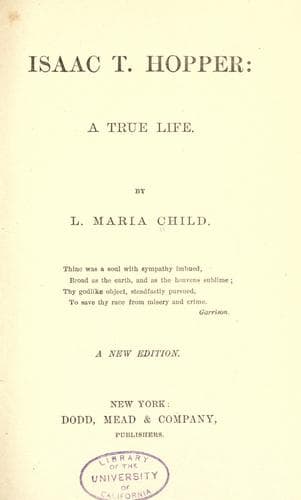
Fugitive slaves -- United States; Hopper, Isaac T. (Isaac Tatem), 1771-1852
"Thou art a very respectable looking man," said Friend Hopper; "but I
have known slaveholders, of even more genteel appearance than thou art,
tell gross falsehoods where a slave was in question. I tell thee
plainly, that I have no confidence in slaveholders, in any such case. I
have had too much acquaintance with them. I know their game too well."
The Southerner said something about its being both mean and wrong to
come between master and servant.
"Such may be thy opinion," replied Friend Hopper; "but my views of duty
differ from thine in this matter." Then turning to the woman, he said,
"By the laws here, thou art free. No man has a right to make thee a
slave again. Thou mayest stay at the North, or go back to New-Orleans,
just as thou choosest."
The Southerner here interposed to say, "Mind what that old gentleman
says. You can go back to New-Orleans, to your husband, if you prefer to
go."
"But let me tell thee," said Friend Hopper to the woman, "that if thou
stayest here, thou wilt be free; but if they carry thee back, they may
sell thee away from thy husband. Dost thou wish to be free?"
The tears gushed from her eyes in full flood, and she replied earnestly,
"I do want to be free. To be _sure I_ do want to be free; but then I
want to go to my husband."
Mr. Morgan and his Southern friend grew excited. With an angry glance at
the old gentleman, the latter exclaimed, "I only wish we had you in
New-Orleans! We'd hang you up in twenty-four hours."
"Then you are a set of savages," replied Friend Hopper.
"_You_ are a set of thieves," retorted he.
"Well, savages may be thieves also," rejoined the abolitionist, with a
significant smile.
"You are no gentleman," responded the other, in an irritated tone.
"I don't profess to be a gentleman," answered the impassive Quaker. "But
I am an honest old man; and perhaps that will do as well."
This remark occasioned a general smile. Indeed it was pleasant to
observe, throughout this scene in the court-room, that popular sympathy
was altogether on the side of freedom. It was a strange blind instinct
on the part of the people, considering how diligently they had been
instructed otherwise by pulpit and press; but so it was.
When the slave was summoned into the judge's room, Friend Hopper
followed; being extremely desirous to have her understand her position
clearly. He found Mr. Morgan and his Southern friend in close and
earnest conversation with her. When he attempted to approach her, he was
unceremoniously shoved aside, with the remark, "Don't push me away!"
"I did not push thee," said Friend Hopper; "and see that thou dost not
push _me_!" He then inquired of the woman if he had rightly understood
that her husband was free. She replied in the affirmative. "Then let me
tell thee," said the kind-hearted old gentleman, "that we will send for
him, and obtain employment for him here, if it is thy choice to
remain."
Public-domain text, read in full here on John Shaqi.
Reviews
Reviews
No reviews yet
Be the first to share your thoughts on this work.
Elsewhere in the archive
Join the Discussion
Join the discussion
Sign in to leave a comment or review.
Sign InorCreate an account