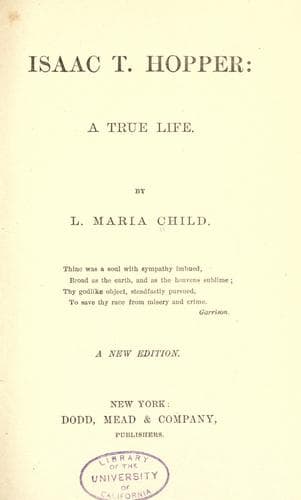
Fugitive slaves -- United States; Hopper, Isaac T. (Isaac Tatem), 1771-1852
Again she wept, and repeated, "I do want to be free." But she was
evidently bewildered and distrustful, and did not know how to understand
the opposite professions that were made to her.
On representation of the claimant's friends, Judge Oakley adjourned the
case till the next morning; telling the woman she was at liberty to go
with whom she pleased. The colored people had assembled in considerable
numbers, and were a good deal excited. Experience led them to suppose
that she would either be cajoled into consenting to return to slavery,
or else secretly packed off to New-Orleans, if she were left in Southern
hands. They accordingly made haste to hustle her away. But their
well-intended zeal terrified the poor bewildered creature, and she
escaped from them, and went back to her mistress.
The pro-slavery papers chuckled, as they always do, when some poor
ignorant victim is deceived by false representation, alarmed by an
excitement that she does not comprehend, afraid that strangers are not
telling her the truth, or that they have not the power to protect her;
and in continual terror of future punishment, if she should attempt to
take her freedom, and yet be unable to maintain it. Great is the triumph
of republicans, when, under such trying circumstances, _one_ poor
bewildered wretch goes back to slavery; but of the _hundreds_, who every
month take their freedom, through fire and flood, and all manner of
deadly perils, they are as silent as the grave.
In the spring of 1841, I went to New-York to edit the Anti-Slavery
Standard, and took up my abode with the family of Isaac T. Hopper. The
zealous theological controversy among Friends naturally subsided after
the separation between the opposing parties had become an old and
settled fact. Consequently the demand for Quaker books diminished more
and more. The Anti-Slavery Society, at that time, needed a Treasurer and
Book-Agent; and Friend Hopper was proposed as a suitable person for that
office. As only a small portion of his time was occupied with the sale
of books he had on hand, he concluded to accept the proposition. He was
then nearly seventy years old; but he appeared at least twenty years
younger, in person and manners. His firm, elastic step seemed like a
vigorous man of fifty. He would spring from the Bowery cars, while they
were in motion, with as much agility as a lad of fourteen. His hair was
not even sprinkled with gray. It looked so black and glossy, that a
young lady, who was introduced to him, said she thought he wore a wig
unnaturally dark for his age. It was a favorite joke of his to make
strangers believe he wore a wig; and they were not easily satisfied
that he spoke in jest, until they examined his head.
Public-domain text, read in full here on John Shaqi.
Reviews
Reviews
No reviews yet
Be the first to share your thoughts on this work.
Elsewhere in the archive
Join the Discussion
Join the discussion
Sign in to leave a comment or review.
Sign InorCreate an account