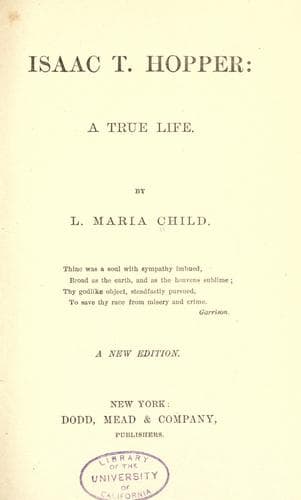
Fugitive slaves -- United States; Hopper, Isaac T. (Isaac Tatem), 1771-1852
He often spoke of the first slave whose escape he managed, in the days
of his apprenticeship. He was wont to exclaim, "How well I remember the
anxious, imploring, look that poor fellow gave me, when I told him I
would be his friend! It rises up before me now. If I were a painter, I
could show it to thee."
But clearly above all other things, did he remember every look and tone
of his beloved Sarah; even in the days when they trudged to school
together, hand in hand. The recollection of this first love, closely
intertwined with his first religious impressions, was the only flowery
spot of romance in the old gentleman's very practical character. When he
was seventy years of age, he showed me a piece of writing she had copied
for him, when she was a girl of fourteen. It was preserved in the
self-same envelope, in which she sent it, and pinned with the same pin,
long since blackened by age. I said, "Be careful not to lose that pin."
"Lose it!" he exclaimed. "No money could tempt me to part with it. I
loved the very ground she trod upon."
He was never weary of eulogizing her comely looks, beautiful manners,
sound principles, and sensible conversation. The worthy companion of his
later life never seemed troubled by such remarks. She not only "listened
to a sister's praises with unwounded ear," but often added a heartfelt
tribute to the virtues of her departed friend.
It is very common for old people to grow careless about their personal
appearance, and their style of conversation; but Friend Hopper was
remarkably free from such faults. He was exceedingly pure in his mind,
and in his personal habits. He never alluded to any subject that was
unclean, never made any indelicate remark, or used any unseemly
expression. There was never the slightest occasion for young people to
feel uneasy concerning what he might say. However lively his mood might
be, his fun was always sure to be restrained by the nicest sense of
natural propriety. He shaved, and took a cold plunge-bath every day. Not
a particle of mud or dust was allowed to remain upon his garments. He
always insisted on blacking his own shoes; for it was one of his
principles not to be waited upon, while he was well enough to wait upon
himself. They were always as polished as japan; and every Saturday
night, his silver buckles were made as bright as a new dollar, in
readiness to go to meeting the next day. His dress was precisely like
that worn by William Penn. At the time I knew him, I believe he was the
only Quaker in the country, who had not departed from that model in the
slightest degree. It was in fact the dress of all English gentlemen, in
King Charles's time; and the only peculiarity of William Penn was, that
he wore it without embroidery or ornament of any kind, for the purpose
of protesting against the extravagance of the fashionable world.
Therefore, the _spirit_ of his intention and that of other early
Friends, would be preserved by wearing dress cut according to the
Public-domain text, read in full here on John Shaqi.
Reviews
Reviews
No reviews yet
Be the first to share your thoughts on this work.
Elsewhere in the archive
Join the Discussion
Join the discussion
Sign in to leave a comment or review.
Sign InorCreate an account