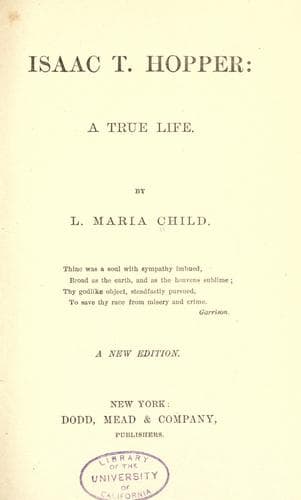
Fugitive slaves -- United States; Hopper, Isaac T. (Isaac Tatem), 1771-1852
prevailing mode, but of plain materials, and entirely unornamented.
However, Friend Hopper was attached to the ancient costume from early
association, and he could not quite banish the idea that any change in
it would be a degree of conformity to the fashions of the world. The
long stockings, and small clothes buckled at the knee, were well adapted
to his finely formed limbs; and certainly he and his lady-like Hannah,
in their quaint garb of the olden time, formed a very agreeable picture.
He had no peculiarities with regard to eating or drinking. He always
followed the old-fashioned substantial mode of living, to which he had
been accustomed in youth, and of which moderation in all things was the
rule. For luxuries he had no taste. He thought very little about his
food; but when it was before him, he ate with the vigorous appetite
natural to strong health and very active habits. When his health failed
for a time in Philadelphia, and he seemed wasting away to a shadow, his
physician recommended tobacco. He found great benefit from it, and in
consequence of the habit then formed he became an inveterate smoker, and
continued so till he was past seventy years old.
Being out of health for a short time, at that period, the doctor told
him he thought smoking was not good for his complaint. He accordingly
discontinued the practice, and formed a resolution not to renew it. When
he recovered, it cost him a good deal of physical annoyance to conquer
the long-settled habit; but he had sufficient strength of mind to
persevere in the difficult task, and he never again used tobacco in any
form. Speaking of this to his son Edward, he said, "The fact is, whoever
cures himself of any selfish indulgence, becomes a better man. It may
seem strange that I should set out to improve at my age; but better late
than never."
He was eminently domestic in his character. Perhaps no man ever lived,
who better enjoyed staying at home. He loved to invite his
grand-children, and write them pleasant little notes about the
squirrel-pie, or some other rarity, which he had in preparation for
them. He seldom went out of his own family circle, except on urgent
business, or to attend to some call of humanity. He was always very
attentive in waiting upon his wife to meeting, or elsewhere, and spent a
large portion of his evenings in reading to her from the newspapers, or
some book of Travels, or the writings of early Friends. No man in the
country had such a complete Quaker library. He contrived to pick up
every rare old volume connected with the history of his sect. He had a
wonderful fondness and reverence for many of those books. They seemed to
stand to him in the place of old religious friends, who had parted from
his side in the journey of life. There, at least, he found Quakerism
that had not degenerated; that breathed the same spirit as of yore.
Public-domain text, read in full here on John Shaqi.
Reviews
Reviews
No reviews yet
Be the first to share your thoughts on this work.
Elsewhere in the archive
Join the Discussion
Join the discussion
Sign in to leave a comment or review.
Sign InorCreate an account