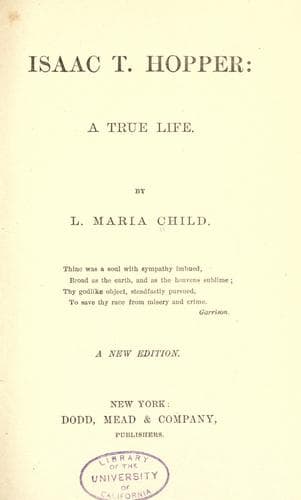
Fugitive slaves -- United States; Hopper, Isaac T. (Isaac Tatem), 1771-1852
I presume that his religious opinions resembled those of Elias Hicks.
But I judged so mainly from incidental remarks; for he regarded
doctrines as of small importance, and considered theology an
unprofitable topic of conversation. Practical righteousness, manifested
in the daily affairs of life, was in his view the sum and substance of
religion. The doctrine of the Atonement never commended itself to his
reason, and his sense of justice was disturbed by the idea of the
innocent suffering for the guilty. He moreover thought it had a
pernicious tendency for men to rely on an abstract article of faith, to
save them from their sins. With the stern and gloomy sects, who are
peculiarly attracted by the character of Deity as delineated in the Old
Testament, he had no sympathy. The Infinite One was ever present to his
mind, as a loving Father to all his children, whether they happened to
call him by the name of Brama, Jehovah, God, or Allah.
He was strongly attached to the forms of Quakerism, as well as to the
principles. It troubled him, when some of his children changed their
mode of dress, and ceased to say _thee_ and _thou_. He groaned when one
of his daughters appeared before him with a black velvet bonnet, though
it was exceedingly simple in construction, and unornamented by feather
or ribbon. She was prepared for this reception, and tried to reconcile
him to the innovation by representing that a white or drab-colored silk
bonnet showed every stain, and was therefore very uneconomical for a
person of active habits. "Thy good mother was a very energetic woman,"
he replied; "but she found no difficulty in keeping her white bonnet as
nice as a new pin." His daughter urged that it required a great deal of
trouble to keep it so; and that she did not think dress was worth so
much trouble. But his groan was only softened into a sigh. The fashion
of the bonnet his Sarah had worn, in that beloved old meeting-house at
Woodbury, was consecrated in his memory; and to his mind, the outward
type also stood for an inward principle. I used to tell him that I found
something truly grand in the original motive for saying _thee_ and
_thou_; but it seemed to me that it had degenerated into a mere
hereditary habit, since the custom of applying _you_ exclusively to
superiors had vanished from the English language. He admitted the force
of this argument; but he deprecated a departure from their old forms,
because he considered it useful, especially to the young, to carry the
cross of being marked and set apart from the world. But though he was
thus strict in what he required of those who had been educated as
Quakers, he placed no barrier between himself and people of other sects.
He loved a righteous man, and sympathized with an unfortunate one,
without reference to his denomination. In fact, many of his warmest and
dearest friends were not members of his own religious society.
Public-domain text, read in full here on John Shaqi.
Reviews
Reviews
No reviews yet
Be the first to share your thoughts on this work.
Elsewhere in the archive
Join the Discussion
Join the discussion
Sign in to leave a comment or review.
Sign InorCreate an account