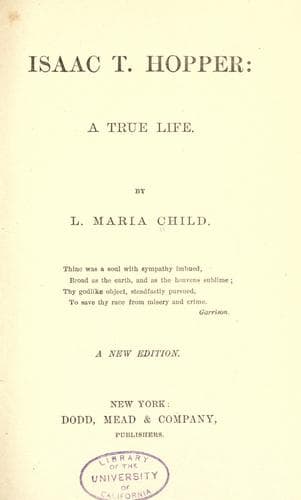
Fugitive slaves -- United States; Hopper, Isaac T. (Isaac Tatem), 1771-1852
His well-known benevolence, his peculiar tact in managing wayward
characters, his undoubted integrity, and his long experience in such
matters, naturally suggested the idea that he was more suitable than any
other person to be Agent of the Association. It was a situation
extremely well-adapted to his character, and if his limited
circumstances would have permitted, he would have been right glad to
have discharged its duties gratuitously. He named three hundred dollars
a year, as sufficient addition to his income, and the duties were
performed with as much diligence and zeal, as if the recompence had been
thousands. Although he was then seventy-four years old, his hand-writing
was firm and even, and very legible. He kept a Diary of every day's
transactions, and a Register of all the discharged convicts who applied
for assistance; with a monthly record of such information as could be
obtained of their character and condition, from time to time. The neat
and accurate manner in which these books were kept was really surprising
in so old a man. The amount of walking he did, to attend to the business
of the Association, was likewise remarkable. Not one in ten thousand,
who had lived so many years, could have endured so much fatigue.
In his labors in behalf of this class of unfortunate people he was
essentially aided by Abby H. Gibbons, who resided nearer to him than his
other daughters, and who had the same affectionate zeal to sustain him,
that she had manifested by secretly slipping a portion of her earnings
into his pocket, in the days of her girlhood. She was as vigilant and
active in behalf of the women discharged from prison, as her father was
in behalf of the men. Through the exertions of herself and other
benevolent women, an asylum for these poor outcasts, called THE HOME,
was established and sustained. Friend Hopper took a deep interest in
that institution, and frequently went there on Sunday evening, with his
wife and daughters, to talk with the inmates in a manner most likely to
soothe and encourage them. They were accustomed to call him "Father
Hopper," and always came to him for advice when they were in trouble.
Public-domain text, read in full here on John Shaqi.
Reviews
Reviews
No reviews yet
Be the first to share your thoughts on this work.
Elsewhere in the archive
Join the Discussion
Join the discussion
Sign in to leave a comment or review.
Sign InorCreate an account