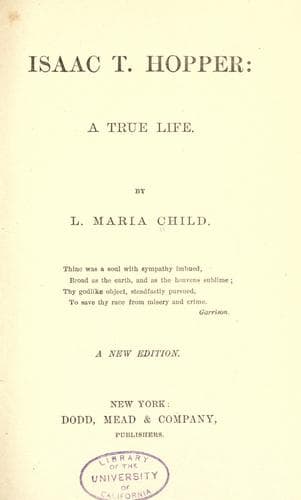
Fugitive slaves -- United States; Hopper, Isaac T. (Isaac Tatem), 1771-1852
When the Prison Association petitioned to be incorporated, it
encountered a great deal of opposition, on the ground that it would be
likely to interfere with the authority of the State over prisons. During
two winters, Friend Hopper went to Albany frequently to sustain the
measure. He commanded respect and attention, by the good sense of his
remarks, his dignified manner, and readiness of utterance. The
Legislature were more inclined to have confidence in him, because he was
known to be a benevolent, conscientious Quaker, entirely unconnected
with party politics. In fact, the measure was carried mainly by the
exertion of his personal influence. He sustained the petition of the
Association in a speech before the Legislature, which excited much
attention, and made a deep impression on those who heard it. Judge
Edmonds, who was one of the speakers on the same occasion, often alluded
to it as a remarkable address. He said, "It elicited more applause, and
did more to carry the end in view, than anything that was said by more
practised public speakers. His eloquence was simple and direct, but most
effective. If he was humorous, his audience were full of laughter; if
solemn, a deathlike stillness reigned; if pathetic, tears flowed all
around him. He seemed unconscious of his power in this respect, but I
have heard him many times before large assemblies at our Anniversaries,
and in the chapel of the State Prison, and I have been struck, over and
over again, with the remarkable sway he had over the minds of those whom
he addressed."
The business of the Association made it necessary for Friend Hopper to
visit that city many times afterward. He came to be so well known there,
and was held in such high respect, that whenever he made his appearance
in the halls of legislation, the Speaker sent a messenger to invite him
to take a seat near his own.
He often applied to the Governor to exert his pardoning power, where he
thought there were mitigating circumstances attending the commission of
a crime; or where the mind and health of a prisoner seemed breaking
down; or where a long course of good conduct seemed deserving of reward.
When Governor Young had become sufficiently acquainted with him to form
a just estimate of his character, he said to him, "Friend Hopper, I will
pardon any convict, whom you say you conscientiously believe I ought to
pardon. If I err at all, I prefer that it should be on the side of
mercy. But so many cases press upon my attention, and it is so difficult
to examine them all thoroughly, that it is a great relief to find a man
in whose judgment and integrity I have such perfect confidence, as I
have in yours." On the occasion of one of these applications for mercy,
the following quaint correspondence passed between him and the Governor:
"Esteemed Friend,
"John Young:
Public-domain text, read in full here on John Shaqi.
Reviews
Reviews
No reviews yet
Be the first to share your thoughts on this work.
Elsewhere in the archive
Join the Discussion
Join the discussion
Sign in to leave a comment or review.
Sign InorCreate an account