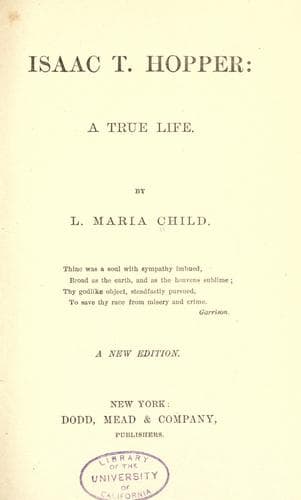
Fugitive slaves -- United States; Hopper, Isaac T. (Isaac Tatem), 1771-1852
Many colored people die every year, and vast numbers have their health
permanently impaired, on account of inclement weather, to which they are
exposed by exclusion from public conveyances. And this merely on account
of complexion! What a tornado of popular eloquence would come from our
public halls, if Austria or Russia were guilty of any despotism half as
mean! Yet the great heart of the people is moved by kind and sincere
feelings in its outbursts against foreign tyranny. But in addition to
this honorable sympathy for the oppressed in other countries, it would
be well for them to look at home, and consider whether it is just that
any well-behaved people should be excluded from the common privileges of
public conveyances. If a hundred citizens in New-York would act as
Friend Hopper did, the evil would soon be remedied. It is the almost
universal failure in individual duty, which so accumulates errors and
iniquities in society, that the ultra-theories, and extra efforts of
reformers become absolutely necessary to prevent the balance of things
from being destroyed; as thunder and lightning are required to purify a
polluted atmosphere. Godwin, in some of his writings, asks, "What is it
that enables a thousand errors to keep their station in the world? It is
cowardice. It is because the majority of men, who see that things are
not altogether right, yet see in so frigid a way, and have so little
courage to express their views. If every man to-day would tell all the
truth he knows, three years hence, there would scarcely be a falsehood
of any magnitude remaining in the civilized world."
In the summer of 1844, Friend Hopper met with a Methodist preacher from
Mississippi, who came with his family to New-York, to attend a General
Conference. Being introduced as a zealous abolitionist, the conversation
immediately turned upon slavery. One of the preacher's daughters said,
"I could'nt possibly get along without slaves, Mr. Hopper. Why I never
dressed or undressed myself, till I came to the North. I wanted very
much to bring a slave with me."
"I wish thou hadst," rejoined Friend Hopper.
"And what would you have done, if you had seen her?" she inquired.
He replied, "I would have told her that she was a free woman while she
remained here; but if she went back to the South, she would be liable
to be sold, like a pig or a sheep."
They laughed at this frank avowal, and when he invited them to come to
his house with their father, to take tea, they gladly accepted the
invitation. Again the conversation turned toward that subject, which is
never forgotten when North and South meet. In answer to some remark from
Friend Hopper, the preacher said, "Do you think I am not a Christian?"
"I certainly do not regard thee as one," he replied.
"And I suppose you think I cannot get to heaven?" rejoined the
slaveholder.
Public-domain text, read in full here on John Shaqi.
Reviews
Reviews
No reviews yet
Be the first to share your thoughts on this work.
Elsewhere in the archive
Join the Discussion
Join the discussion
Sign in to leave a comment or review.
Sign InorCreate an account