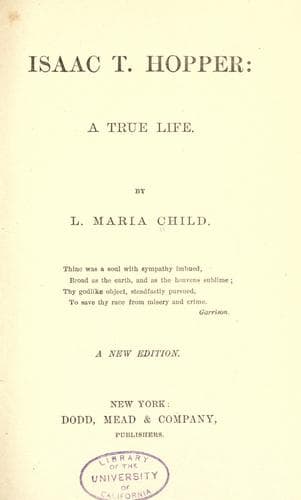
Fugitive slaves -- United States; Hopper, Isaac T. (Isaac Tatem), 1771-1852
"I will not say that," replied the Friend. "To thy own Master thou must
stand or fall. But slavery is a great abomination, and no one who is
guilty of it can be a Christian, or Christ-like. I would not exclude
thee from the kingdom of heaven; but if thou dost enter there, it must
be because thou art ignorant of the fact that thou art living in sin."
After a prolonged conversation, mostly on the same topic, the guests
rose to depart. The Methodist said, "Well, Mr. Hopper, I have never been
treated better by any man, than I have been by you. I should be very
glad to have you visit us."
"Ah! and thou wouldst lynch me; or at least, thy friends would," he
replied, smiling.
"Oh no, we would treat you very well," rejoined the Southerner. "But
how would you talk about slavery if you were there?"
"Just as I do here, to be sure," answered the Quaker. "I would advise
the slaves to be honest, industrious, and obedient, and never try to run
away from a good master, unless they were pretty sure of escaping;
because if they were caught, they would fare worse than before. But if
they had a safe opportunity, I should advise them to be off as soon as
possible." In a more serious tone, he added, "And to thee, who claimest
to be a minister of Christ, I would say that thy Master requires thee to
give deliverance to the captive, and let the oppressed go free. My
friend, hast thou a conscience void of offence? When thou liest down at
night, is thy mind always at ease on this subject? After pouring out thy
soul in prayer to thy Heavenly Father, dost thou not feel the outraged
sense of right, like a perpetual motion, restless within thy breast?
Dost thou not hear a voice telling thee it is wrong to hold thy fellow
men in slavery, with their wives and their little ones?"
The preacher manifested some emotion at this earnest appeal, and
confessed that he sometimes had doubts on the subject; though, on the
whole, he had concluded that it was right to hold slaves. One of his
daughters, who was a widow, seemed to be more deeply touched. She took
Friend Hopper's hand, at parting, and said, "I am thankful for the
privilege of having seen you. I never talked with an abolitionist
before. You have convinced me that slave-holding is sinful in the sight
of God. My husband left me several slaves, and I have held them for five
years; but when I return, I am resolved to hold a slave no longer."
Friend Hopper cherished some hope that this preaching and praying
slaveholder would eventually manumit his bondmen; but I had listened to
his conversation, and I thought otherwise. His conscience seemed to me
to be asleep under a seven-fold shield of self-satisfied piety; and I
have observed that such consciences rarely waken.
Public-domain text, read in full here on John Shaqi.
Reviews
Reviews
No reviews yet
Be the first to share your thoughts on this work.
Elsewhere in the archive
Join the Discussion
Join the discussion
Sign in to leave a comment or review.
Sign InorCreate an account