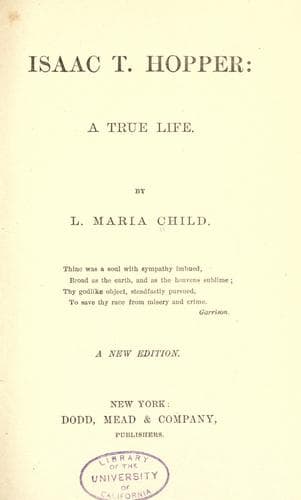
Fugitive slaves -- United States; Hopper, Isaac T. (Isaac Tatem), 1771-1852
In the summer of 1848, when I was staying in the country, not far from
New-York, I received the following letter from him: "Dear Friend, the
days have not yet come, in which I can say I have no pleasure in them.
Notwithstanding the stubs against which I hit my toes, the briars and
thorns that sometimes annoy me, and the muddy sloughs I am sometimes
obliged to wade through, yet, after all, the days have _not_ come in
which I have no enjoyment. In the course of my journey, I find here and
there a green spot, by which I can sit down and rest, and pleasant
streams, where I sometimes drink, mostly in secret, and am refreshed. I
often remember the saying of a beloved friend, long since translated
from this scene of mutation to a state of eternal beatitude: 'I wear my
sackcloth on my loins; I don't wish to afflict others by carrying a
sorrowful countenance.' A wise conclusion. I love to diffuse happiness
over all with whom I come in contact. But all this is a kind of
accident. I took up my pen to tell thee about our garden. I never saw it
half so handsome as it is now. Morning Glories are on both sides of the
yard, extending nearly to the second story windows; and they exhibit
their glories every morning, in beautiful style. There are Cypress
vines, twelve feet high, running up on the pillar before the kitchen
window, and spreading out each way. They blossom most profusely. The
wooden wall is entirely covered with Madeira vines, and the stone wall
with Woodbine. The grass-plot is very thrifty, and our borders are
beautified with a variety of flowers. How thou wouldst like to look at
them!"
I replied as follows: "My dear and honored friend: Your kind, cheerful
epistle came into my room as pleasantly as would the vines and flowers
you describe. I am very glad the spirit moved you to write; for, to use
the words of the apostle, I thank my God for every remembrance of you.'
I do not make many professions of friendship, because neither you nor I
are much given to professions; but there is no one in the world for whom
I have a higher respect than yourself, and very few for whom I cherish a
more cordial affection. You say the time has not _yet_ come when you
have no pleasure. I think, my friend, that it will _never_ come. To an
evergreen heart, like yours, so full of kindly sympathies, the little
children will always prattle, the birds will always sing, and the
flowers will always offer incense. _This_ reward of the honest and
kindly heart is one of those, which 'the world can neither give nor take
away.'
"I should love to see your garden now. There is a peculiar satisfaction
in having a very _little_ patch all blooming into beauty. I had such an
one in my humble home in Boston, some years ago. It used to make me
think of Mary Howitt's very pleasant poetry:
"'Yes, in the poor man's garden grow
Far more than herbs and flowers;
Kind thoughts, contentment, peace of mind,
And joy for weary hours.'
Public-domain text, read in full here on John Shaqi.
Reviews
Reviews
No reviews yet
Be the first to share your thoughts on this work.
Elsewhere in the archive
Join the Discussion
Join the discussion
Sign in to leave a comment or review.
Sign InorCreate an account