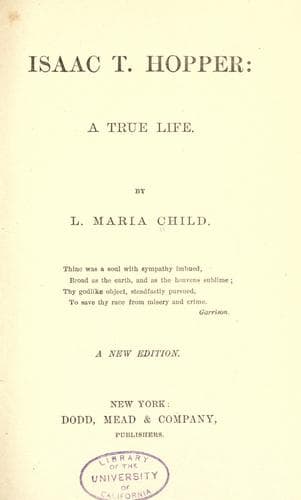
Fugitive slaves -- United States; Hopper, Isaac T. (Isaac Tatem), 1771-1852
"I have one enjoyment this summer, which you cannot have in your city
premises. The birds! not only their sweet songs, but all their little
cunning manoeuvres in courting, building their nests, and rearing their
young. I watched for hours a little Phoebe-bird, who brought out her
brood to teach them to fly. They used to stop to rest themselves on the
naked branch of a dead pear-tree. There they sat so quietly, all in a
row, in their sober russet suit of feathers, just as if they were
Quakers at meeting. The birds are very tame here; thanks to Friend
Joseph's tender heart. The Bob-o-links pick seed from the dandelions,
at my very feet. May you sleep like a child when his friends are with
him, as the Orientals say. And so farewell."
Interesting strangers occasionally called to see Friend Hopper,
attracted by his reputation. Frederika Bremer was peculiarly delighted
by her interviews with him, and made a fine sketch of him in her
collection of American likenesses. William Page, the well-known artist,
made for me an admirable drawing of him, when he was a little past
seventy years old. Eight years after, Salathiel Ellis, of New-York, at
the suggestion of some friends, executed an uncommonly fine medallion
likeness. A reduced copy of this was made in bronze at the request of
some members of the Prison Association. The reverse side represents him
raising a prisoner from the ground, and bears the appropriate
inscription, "To seek and to save that which was lost."
Young people often sent him pretty little testimonials of the interest
he had excited in their minds. Intelligent Irish girls, with whom he had
formed acquaintance in their native land, never during his life ceased
to write to him, and occasionally sent some tasteful souvenir of their
friendship. The fashionable custom of New-Year's and Christmas offerings
was not in his line. But though he always dined on humble fare at
Christmas, as a testimony against the observance of holy days, he
secretly sent turkeys to poor families, who viewed the subject in a
different light; and it was only by accidental circumstances that they
at last discovered to whom they owed the annual gift.
[Illustration]
Public-domain text, read in full here on John Shaqi.
Reviews
Reviews
No reviews yet
Be the first to share your thoughts on this work.
Elsewhere in the archive
Join the Discussion
Join the discussion
Sign in to leave a comment or review.
Sign InorCreate an account