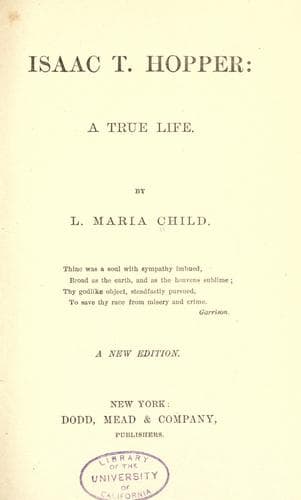
Fugitive slaves -- United States; Hopper, Isaac T. (Isaac Tatem), 1771-1852
Writing to his daughter Sarah in 1845, he thus returns to the same
beloved theme: "I lately happened to open the Memoirs of Sarah Harrison.
It seemed to place me among my old friends, with whom I walked in sweet
unity and Christian fellowship, in days that are gone forever. I there
saw the names, and read the letters, of William Savery, Thomas
Scattergood, and a host of others, who have long since gone to their
everlasting rest. I hope, however unworthy, to join them at some day,
not very distant."
"Next day after to-morrow, it will be fifty years since I was married to
thy dear mother. How fresh many of the scenes of that day are brought
before me! It almost seems as if they transpired yesterday. These
reminiscences afford me a melancholy pleasure, and I love to indulge in
them. No man has experienced more exquisite pleasure, or deeper sorrows
than I have."
Perhaps the reader will say that I have spoken little of his sorrows;
and it is true. But who does not know that all the sternest conflicts of
life can never be recorded! Every human soul must walk alone through
the darkest and most dangerous paths of its spiritual pilgrimage;
absolutely alone with God! Much, from which we suffer most acutely,
could never be revealed to others; still more could never be understood,
if it were revealed; and still more ought never to be repeated, if it
could be understood. Therefore, the frankest and fullest biography must
necessarily be superficial.
The old gentleman was not prone to talk of his troubles. They never made
him irritable, but rather increased his tenderness and thoughtfulness
toward others. His naturally violent temper was brought under almost
complete subjection. During the nine years that I lived with him, I
never saw him lose his balance but twice; and then it was only for a
moment, and under very provoking circumstances.
The much-quoted line, "None knew him but to love him, none named him but
to praise," was probably never true of any man; certainly not of any one
with a strong character. Many were hostile to Friend Hopper, and some
were bitter in their enmity. Of course, it could not be otherwise with a
man who battled with oppression, selfishness, and bigotry, wherever he
encountered them, and whose rebukes were too direct and explicit to be
evaded. Moreover, no person in this world is allowed to be peculiar and
independent with impunity. There are always men who wish to compel such
characters to submit, by the pressure of circumstances. This kind of
spiritual thumb-screw was often, and in various ways, tried upon Friend
Hopper; but though it sometimes occasioned temporary inconvenience, it
never induced him to change his course.
Public-domain text, read in full here on John Shaqi.
Reviews
Reviews
No reviews yet
Be the first to share your thoughts on this work.
Elsewhere in the archive
Join the Discussion
Join the discussion
Sign in to leave a comment or review.
Sign InorCreate an account