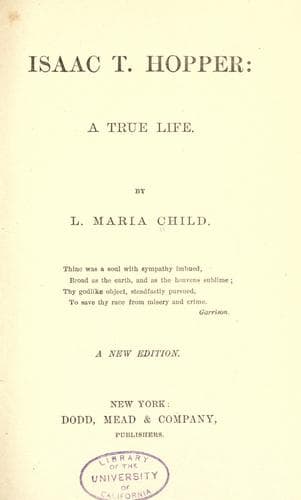
Fugitive slaves -- United States; Hopper, Isaac T. (Isaac Tatem), 1771-1852
Members of the Society of Friends often came to see him; and for many of
them he cherished high respect, and a very warm friendship. But his
character grew larger, and his views more liberal, after the bonds which
bound him to a sect were cut asunder. Friends occasionally said to him,
"We miss thy services in the Society, Isaac. Hadst thou not better ask
to be re-admitted? The way is open for thee, whenever thou hast an
inclination to return." He replied, "I thank thee. But in the present
state of the Society, I don't think I could be of any service to them,
or they to me." But he could never relinquish the hope that the
primitive character of Quakerism would be restored, and that the Society
would again hold up the standard of righteousness to the nations, as it
had in days gone by. Nearly every man, who forms strong religious
attachments in early life, cherishes similar anticipations for his sect,
whose glory declines, in the natural order of things. But such hopes are
never realized. The spirit has a resurrection, but not the form. "Soul
never dies. Matter dies off it, and it lives elsewhere." Thus it is with
truth. The noble principles maintained by Quakers, through suffering
and peril, have taken root in other sects, and been an incalculable help
to individual seekers after light, throughout the Christian world. Like
winged seed scattered in far-off soils, they will produce a
forest-growth in the future, long after the original stock is dead, and
its dust dispersed to the winds.
In Friend Hopper's last years, memory, as usual with the old, was busily
employed in reproducing the past; and in his mind the pictures she
presented were uncommonly vivid. In a letter to his daughter, Sarah
Palmer, he writes: "I was deeply affected on being informed of the death
of Joseph Whitall. We loved one another when we were children; and I
never lost my love for him. I think it will not be extravagant if I say
that my soul was knit with his soul, as Jonathan's was to David's. I
have a letter, which I received from him in 1795. I have not language to
express my feelings. Oh, that separation! that cruel separation! How it
divided very friends!"
In a letter to his daughter Susan, we again find him looking fondly
backward. He says: "I often, very often remember the example of thy dear
mother, with feelings that no language can portray. She was neat and
tasteful in her appearance. Her dress was elegant, but plain, as became
her Christian profession. She loved sincere Friends, faithfully
maintained all their testimonies, and was a diligent attender of
meetings. She was kind and affectionate to all. In short, she was a
bright example in her family, and to all about her, and finally laid
down her head in peace. May her children imitate her virtues."
Public-domain text, read in full here on John Shaqi.
Reviews
Reviews
No reviews yet
Be the first to share your thoughts on this work.
Elsewhere in the archive
Join the Discussion
Join the discussion
Sign in to leave a comment or review.
Sign InorCreate an account