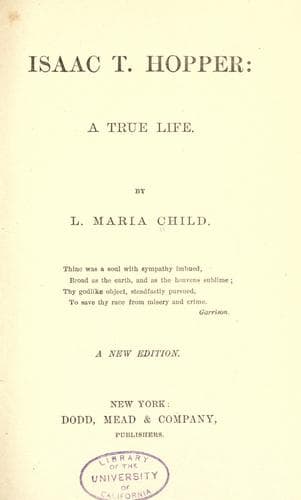
Fugitive slaves -- United States; Hopper, Isaac T. (Isaac Tatem), 1771-1852
He had no need to make a will; for he died, as he had lived, without
property. But he disposed of his little keepsakes with as much
cheerfulness as if he had been making New-Year's presents. He seemed to
remember everybody in the distribution. His Quaker library was left in
the care of his children, with directions that it should be kept where
members of the Society of Friends or others interested could have ready
access to it. To his daughter Sarah he entrusted the paper written by
her mother, at fourteen years of age; still fastened by the pin she had
placed in it, which her dear hand had invested with more value than a
diamond, in his eyes. He earnestly recommended his wife to the
affectionate care of his children; reminding them that she had been a
kind and faithful companion to him during many years. He also gave
general directions concerning his funeral. "Don't take the trouble to
make a shroud," said he. "One of my night-shirts will do as well. I
should prefer to be buried in a white pine coffin; but that might be
painful to my family; and I should not like to afflict them in _any_
way. It may, therefore, be of dark wood; but be sure to have it entirely
plain, without varnish or inscription. Have it made by some poor
neighbor, and pay him the usual price of a handsome one; for I merely
wish to leave a testimony against vain show on such occasions." He
appeared to be rather indifferent where he was buried; but when he was
informed that his son and daughter had purchased a lot at Greenwood
Cemetery, it seemed pleasant to him to think of having them and their
families gathered round him, and he consented to be laid there.
Public-domain text, read in full here on John Shaqi.
Reviews
Reviews
No reviews yet
Be the first to share your thoughts on this work.
Elsewhere in the archive
Join the Discussion
Join the discussion
Sign in to leave a comment or review.
Sign InorCreate an account