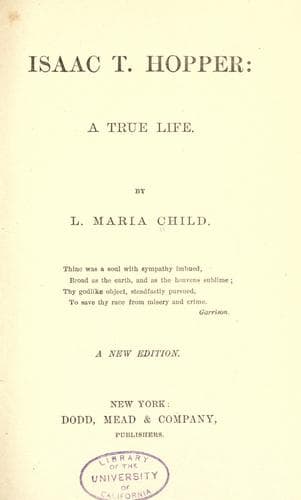
Fugitive slaves -- United States; Hopper, Isaac T. (Isaac Tatem), 1771-1852
I was summoned to his death-bed, and arrived two days before his
departure. I found his mind perfectly bright and clear. He told over
again some of his old reminiscences, and indulged in a few of his
customary pleasantries. He spoke of rejoining his beloved Sarah, and his
ancient friends William Savery, Nicholas Waln, Thomas Scattergood, and
others, with as much certainty and pleasure as if he had been
anticipating a visit to Pennsylvania. Sometimes, when he was much
exhausted with physical pain, he would sigh forth, "Oh, for rest in the
kingdom of heaven!" But nothing that approached nearer to complaint or
impatience escaped his lips. On the last day, he repeated to me, what
he had previously said to others, that he sometimes seemed to hear
voices singing, "We have come to take thee home." Once, when no one else
happened to be near him, he said to me in a low, confidential tone,
"Maria, is there anything peculiar in this room?" I replied, "No. Why do
you ask that question?" "Because," said he, "you all look so beautiful;
and the covering on the bed has such glorious colors, as I never saw.
But perhaps I had better not have said anything about it." The natural
world was transfigured to his dying senses; perhaps by an influx of
light from the spiritual; and I suppose he thought I should understand
it as a sign that the time of his departure drew nigh. It was a scene to
remind one of Jeremy Taylor's eloquent words: "When a good man dies, one
that hath lived innocently, then the joys break forth through the clouds
of sickness, and the conscience stands upright, and confesses the
glories of God: and owns so much integrity, that it can hope for pardon,
and obtain it too. Then the sorrows of sickness do but untie the soul
from its chain, and let it go forth, first into liberty, and then into
glory."
A few hours before he breathed his last, he rallied from a state of
drowsiness, and asked for a box containing his private papers. He washed
to find one, which he thought ought to be destroyed, lest it should do
some injury. He put on his spectacles, and looked at the papers which
were handed him; but the old man's eyes were dimmed with death, and he
could not see the writing. After two or three feeble and ineffectual
attempts, he took off his spectacles, with a trembling hand, and gave
them to his beloved daughter, Sarah, saying, "Take them, my child, and
keep them. They were thy dear mother's. I can never use them more." The
scene was inexpressibly affecting; and we all wept to see this untiring
friend of mankind compelled at last to acknowledge that he could work no
longer.
Public-domain text, read in full here on John Shaqi.
Reviews
Reviews
No reviews yet
Be the first to share your thoughts on this work.
Elsewhere in the archive
Join the Discussion
Join the discussion
Sign in to leave a comment or review.
Sign InorCreate an account