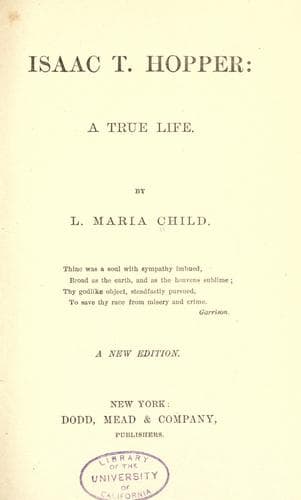
Fugitive slaves -- United States; Hopper, Isaac T. (Isaac Tatem), 1771-1852
Manuel was an active, intelligent slave in North Carolina. His master,
Mr. Joseph Spear, a tar manufacturer, employed him to transport tar, and
other produce of the place, down Tar river to Tarborough. After
laboring several years for another's benefit, Manuel began to feel
anxious to derive some advantage from his own earnings. He had children,
and it troubled him to think that they must live and die in slavery. He
was acquainted with a colored man in the neighborhood, named Samuel
Curtis, who had a certificate of freedom drawn up by the clerk of the
county, and duly authenticated, with the county seal attached to it.
Manuel thought he could easily pass for Samuel Curtis, and make his way
to Philadelphia, if he could only obtain possession of this valuable
paper. He accordingly made him a confidant of his plans, and he bought
the certificate for two dollars.
The next time Manuel was sent to Tarborough, he delivered the cargo as
usual, then left the boat and started for the North. He arrived safely
in Philadelphia, where he assumed the name of Samuel Curtis, and earned
a living by sweeping chimneys. In a short time, he had several boys in
his employ, and laid by money. When he had been going on thus for about
two years, he was suddenly met in the street by one of the neighbors of
his old master, who immediately arrested him as a fugitive from slavery.
He was taken before Robert Wharton, then mayor. The stranger declared
that the colored man he had seized was a slave, belonging to one of his
near neighbors in North Carolina. Samuel denied that he was a slave,
and showed his certificate of freedom. The stranger admitted that the
document was authentic, but he insisted that the real name of the person
who had possession of the paper was Manuel. He said he knew him
perfectly well, and also knew Samuel Curtis, who was a free colored man
in his neighborhood. The mayor decided that he could not receive parole
evidence in contradiction to a public record; and Samuel Curtis was set
at liberty.
To the honor of this worthy magistrate be it recorded that during forty
years whilst he was alderman in Philadelphia, and twenty years that he
was mayor, he never once surrendered a fugitive slave to his claimant,
though frequently called upon to do so. He used to tell Friend Hopper
that he could not conscientiously do it; that he would rather resign his
office. He often remarked that the Declaration, "All men are created
equal; they are endowed by their Creator with certain inalienable
rights; among these are life, liberty, and the pursuit of happiness;"
appeared to him based on a sacred principle, paramount to all law.
Public-domain text, read in full here on John Shaqi.
Reviews
Reviews
No reviews yet
Be the first to share your thoughts on this work.
Elsewhere in the archive
Join the Discussion
Join the discussion
Sign in to leave a comment or review.
Sign InorCreate an account