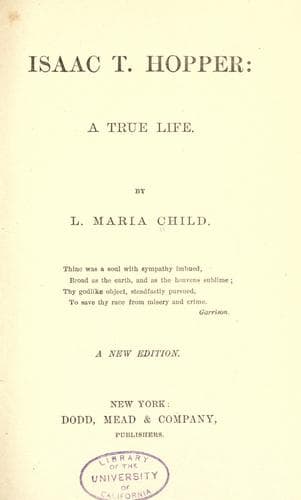
Fugitive slaves -- United States; Hopper, Isaac T. (Isaac Tatem), 1771-1852
When Samuel Curtis was discharged, he deemed it expedient to go to
Boston; thinking he might be safer there than in Philadelphia. But he
had not been there many days, before he met the same man who had
previously arrested him; and he by no means felt sure that the mayor of
that city would prove as friendly to the colored people as was Robert
Wharton. To add to his troubles, some villain broke open his trunk while
he was absent from his lodgings, and stole a hundred and fifty dollars
of his hard earnings. The poor fugitive began to think there was no safe
resting-place for him on the face of the earth. He returned to
Philadelphia disconsolate and anxious. He was extremely diligent and
frugal, and every year he contrived to save some money, which he put out
at interest in safe hands. At last, he was able to purchase a small lot
in Powell-street, on which he built a good three-story brick house,
where he lived with his apprentices, and let some of the rooms at a good
profit.
In 1807, he called upon Friend Hopper and told him that his eagerness to
make money had chiefly arisen from a strong desire to redeem his
children from bondage. But being a slave himself, he said it was
impossible for him to go in search of them, unless his own manumission
could be obtained. It happened that a friend of Isaac T. Hopper was
going to North Carolina. He agreed to see the master and ascertain what
could be done. Mr. Spear never expected to hear from his slave again,
and the proposition to buy him after so many years had elapsed, seemed
like finding a sum of money. He readily agreed to make out a bill of
sale for one hundred dollars, which was immediately paid.
The first use Samuel Curtis made of the freedom he had purchased was to
set off for the South in search of his children. To protect himself as
much as possible from the perils of such an undertaking, he obtained a
certificate of good character, signed by the mayor of Philadelphia, and
several of the most respectable citizens. They also gave him "a pass"
stating the object of his journey, and commending him to the protecting
kindness of those among whom he might find it necessary to travel. With
these he carefully packed his deed of manumission, and set forth on his
errand of paternal love. When he went to take leave of Friend Hopper, he
was much agitated. He clasped his hand fervently, and the tears flowed
fast down his weather-beaten cheeks. "I know I am going into the midst
of danger," said he. "Perhaps I may be seized and sold into slavery. But
I am willing to hazard everything, even my own liberty, if I can only
secure the freedom of my children. I have been a slave myself, and I
know what slaves suffer. Farewell! Farewell, my good friend. May God
bless you, and may he restore to me my children. Then I shall be a happy
man."
Public-domain text, read in full here on John Shaqi.
Reviews
Reviews
No reviews yet
Be the first to share your thoughts on this work.
Elsewhere in the archive
Join the Discussion
Join the discussion
Sign in to leave a comment or review.
Sign InorCreate an account