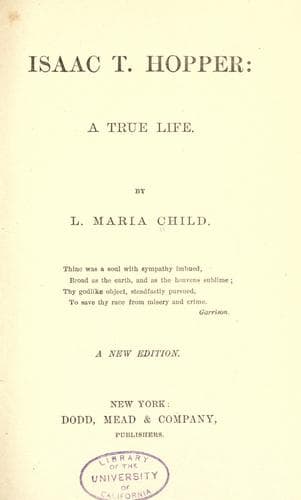
Fugitive slaves -- United States; Hopper, Isaac T. (Isaac Tatem), 1771-1852
When the Frenchman called for his slave next morning, they refused to
discharge him; and he obtained a writ of _habeas corpus_, to bring the
case before the mayor's court. Friend Hopper was informed that the slave
was on trial, that the Recorder did not think it necessary to notify
him, and had made very severe remarks concerning the fictitious debt
assumed for the occasion. He proceeded directly to the court, which was
thronged with people, who watched him with lively curiosity, and made a
lane for him to pass through. Mahlon Dickinson, the Recorder, was in the
act of giving his decision on the case, and he closed his remarks by
saying, "The conduct of Mr. Hopper has been highly reprehensible. The
man is not his debtor; and the pretence that he was so could have been
made for no other reason but to cause unnecessary delay, vexation, and
expense." The lawyers smiled at each other, and seemed not a little
pleased at hearing him so roughly rebuked; for many of them had been
more or less annoyed by his skill and ready wit in tangling their
skein, in cases where questions of freedom were involved. Friend Hopper
stood before the Recorder, looking him steadfastly in the face, while he
was making animadversions on his conduct; and when he had finished, he
respectfully asked leave to address the court for a few minutes.
"Well, Mr. Hopper," said the Recorder, "what have you to say in
justification of your very extraordinary proceedings?"
He replied, "It is true the man is not my debtor; but the court has
greatly erred in supposing that the step I have taken was merely
intended to produce unnecessary delay and expense. The Recorder will
doubtless recollect that Congress has passed an act prohibiting the
introduction of foreign slaves into this country. It is my belief that
the case now before the court is embraced within the provisions of that
act. But I needed time to ascertain the point; and I assumed that the
man was my debtor merely to detain him until the Act of Congress could
be examined."
Jared Ingersoll, an old and highly respectable lawyer, rose to say, "May
it please your honors, I believe Mr. Hopper is correct in his opinion. A
National Intelligencer containing the Act of Congress is at my office,
and I will send for it if you wish." The paper was soon brought, and
Friend Hopper read aloud the section which Mr. Ingersoll pointed out;
placing strong emphasis on such portions as bore upon the case then
pending. When he had concluded, he observed, "I presume the court must
now be convinced that the censures so liberally bestowed on my conduct
are altogether unmerited."
Public-domain text, read in full here on John Shaqi.
Reviews
Reviews
No reviews yet
Be the first to share your thoughts on this work.
Elsewhere in the archive
Join the Discussion
Join the discussion
Sign in to leave a comment or review.
Sign InorCreate an account