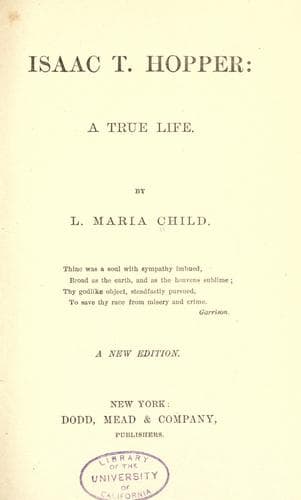
Fugitive slaves -- United States; Hopper, Isaac T. (Isaac Tatem), 1771-1852
The counsel for the claimant said a newspaper was not legal evidence of
the existence of a law. Friend Hopper replied, "The court is well aware
that I am no lawyer. But I have heard lawyers talk about _prima facie_
evidence; and I should suppose the National Intelligencer amounted at
least to that sort of evidence, for it is the acknowledged organ of
government, in which the laws are published for the information of
citizens. But if that is not satisfactory, I presume the court will
detain the man until an authenticated copy of the law can be obtained."
After some discussion, the court ordered a copy of the law to be
procured; but the attorney abandoned the case, and the slave was set at
liberty.
As soon as this decision was announced, the throng of spectators, white
and colored, began to shout, "Hurra for Mr. Hopper!" The populace were
so accustomed to see him come off victorious from such contests, that
they began to consider his judgment infallible.
Many years afterward, when Friend Hopper met Mahlon Dickinson on board
a steam-boat, he inquired whether he recollected the scolding he gave
him on a certain occasion. He replied pleasantly, "Indeed I do. I
thought I _had_ you that time, and I intended to give it to you; but you
slipped through my fingers, as usual."
THE NEW-JERSEY SLAVE.
In the year 1809, a gentleman from East New-Jersey visited Philadelphia,
and brought a young slave to wait upon him. When they had been in that
city four or five months, the lad called upon Isaac T. Hopper to inquire
whether his residence in Philadelphia had made him free. He was informed
that he would not have a legal claim to freedom till he had been there
six months. Just as the term expired, somebody told the master that the
laws of Pennsylvania conferred freedom on slaves under such
circumstances. He had been ignorant of the fact, or had forgotten it,
and as soon as he received the information he became alarmed lest he
should lose his locomotive property. He sent for a constable, who came
to his door with a carriage. The lad had just come up from the cellar
with an armful of wood. When he entered the parlor, the constable
ordered him to put it down and go with him. He threw the wood directly
at the legs of the officer, and ran down cellar full speed, slamming the
door after him. As soon as the constable could recover from the blow he
had received, he followed the lad into the cellar; but he had escaped by
another door, and gone to Isaac T. Hopper.
Public-domain text, read in full here on John Shaqi.
Reviews
Reviews
No reviews yet
Be the first to share your thoughts on this work.
Elsewhere in the archive
Join the Discussion
Join the discussion
Sign in to leave a comment or review.
Sign InorCreate an account