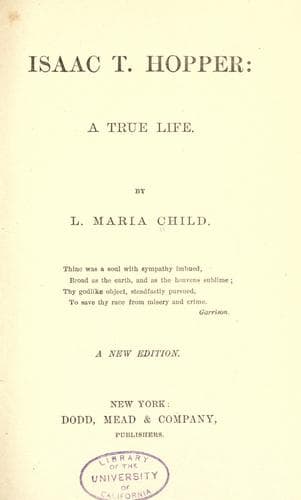
Fugitive slaves -- United States; Hopper, Isaac T. (Isaac Tatem), 1771-1852
The first step in the process of securing the lad's freedom was to
obtain proof that he had been in Philadelphia six months. The landlord
of the hotel where the master lodged, refused to say anything on the
subject, being unwilling to offend his lodger. But the servants were
under no such prudential restraint; and from them Friend Hopper obtained
testimony sufficient for his purpose. He then wrote a note to the
alderman that he would be at his office with the lad at nine o'clock
next morning, and requesting him to inform the claimant. In the mean
time, he procured a writ of _habeas corpus_, to have it in readiness in
case circumstances required it. The claimant made his appearance at the
appointed hour, and stated how he had come to Philadelphia on a visit,
and brought a slave to attend upon him. He descanted quite largely upon
the courtesy due from citizens of one state to those of another state.
Friend Hopper was about to reply, when the magistrate interrupted him by
saying, "I shall not interfere with the citizens of other states. I
shall surrender the boy to his master. If he thinks he has a legal claim
to his freedom, let him prosecute it in New-Jersey."
Friend Hopper said nothing, but gave a signal to have the writ served.
The magistrate was highly offended, and asked in an angry tone, "What
was your object in procuring a writ of _habeas corpus_?"
Friend Hopper replied, "From my knowledge of thee, I anticipated the
result that has just occurred; and I determined to remove the case to a
tribunal where I had confidence that justice would be done in the
premises."
The Court of Common Pleas was then in session. The case was brought
before it the next day, and after the examination of two or three
witnesses, the lad was declared free.
A SLAVE HUNTER DEFEATED.
In 1810, a slave escaped from Virginia to Philadelphia. In a few months,
his master heard where he was, and caused him to be arrested. He was a
fine looking young man, apparently about thirty years old. When he was
brought before Alderman Shoemaker, that magistrate's sympathy was so
much excited, that he refused to try the case unless some one was
present to defend the slave. Isaac T. Hopper was accordingly sent for.
When he had heard a statement of the case, he asked the agent of the
slaveholder to let him examine the Power of Attorney by which he had
been authorized to arrest a "fugitive from labor," and carry him to
Virginia. The agent denied his right to interfere, but Alderman
Shoemaker informed him that Mr. Hopper was a member of the Emancipation
Society, and had a right to be satisfied.
Public-domain text, read in full here on John Shaqi.
Reviews
Reviews
No reviews yet
Be the first to share your thoughts on this work.
Elsewhere in the archive
Join the Discussion
Join the discussion
Sign in to leave a comment or review.
Sign InorCreate an account