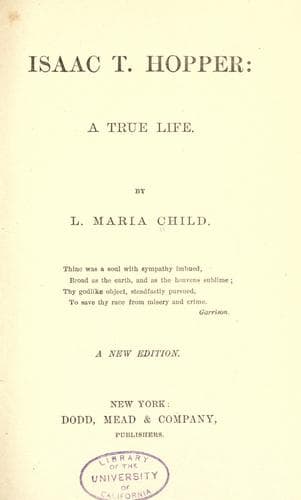
Fugitive slaves -- United States; Hopper, Isaac T. (Isaac Tatem), 1771-1852
The Power of Attorney was correctly drawn, and had been acknowledged in
Washington, before Bushrod Washington, one of the judges of the Supreme
Court of the United States. Friend Hopper's keen eye could detect no
available flaw in it. When the agent had been sworn to answer truly all
questions relating to the case, he inquired whether the fugitive he was
in search of had been advertised; if so, he wished to see the
advertisement. It was handed to him, and he instantly noticed that it
was headed "Sixty Dollars Reward."
"Art thou to receive sixty dollars for apprehending the man mentioned in
this advertisement?" said he.
The agent replied, "I am to receive that sum provided I take him home to
Virginia."
"How canst thou prove that the man thou hast arrested is the one here
advertised?" inquired he.
The agent answered that he could swear to the fact.
"That may be," rejoined Friend Hopper; "but in Philadelphia we do not
allow any person, especially a stranger, to swear sixty dollars into his
own pocket. Unless there is better evidence than thy oath, the man must
be set at liberty."
The agent became extremely irritated, and said indignantly, "Do you
think I would swear to a lie?"
"Thou art a stranger to me," replied Friend Hopper. "I don't know
whether thou wouldst swear falsely or not. But there is one thing I do
know; and that is, I am not willing to trust thee."
The agent reiterated, "I know the man standing there as well as I know
any man living. I am perfectly sure he is the slave described in the
advertisement. I was overseer for the gentleman who owns him. If you
examine his back, you will find scars of the whip."
"And perhaps thou art the man who made the scars, if he has any,"
rejoined the Friend.
Without replying to this suggestion, the slave-hunter ordered the
colored man to strip, that his back might be examined by the court.
Friend Hopper objected to such a proceeding. "Thou hast produced no
evidence that the man thou hast arrested is a slave," said he. "Thou and
he are on the same footing before this court. We have as good a right to
examine thy back, as are have to examine his." He added, with a very
significant tone, "In some places, they whip for kidnapping."
This remark put the slave-hunter in a violent rage. The magistrate
decided that his evidence was not admissible, on the ground that he was
interested. He then proposed to summon two witnesses from a Virginian
vessel lying at one of the wharves.
Public-domain text, read in full here on John Shaqi.
Reviews
Reviews
No reviews yet
Be the first to share your thoughts on this work.
Elsewhere in the archive
Join the Discussion
Join the discussion
Sign in to leave a comment or review.
Sign InorCreate an account