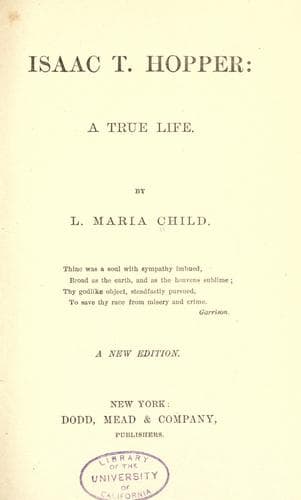
Fugitive slaves -- United States; Hopper, Isaac T. (Isaac Tatem), 1771-1852
A woman, who was born too early to derive benefit from the gradual
emancipation law of Pennsylvania, escaped from bondage in Lancaster
County to Philadelphia. There she married a free colored man by the name
of Abraham Morris. They lived together very comfortably for several
years, and seemed to enjoy life as much as many of their more wealthy
neighbors. But in the year 1810, it unfortunately happened that Mary's
master ascertained where she lived, and sent a man to arrest her, with
directions either to sell her, or bring her back to him.
Abraham Morris was a very intelligent, industrious man, and had laid up
some money. He offered one hundred and fifty dollars of his earnings to
purchase the freedom of his wife. The sum was accepted, and the parties
applied to Daniel Bussier, a magistrate in the District of Southwark, to
draw up a deed of manumission. The money was paid, and the deed given;
but the agent employed to sell the woman absconded with the money. The
master, after waiting several months and not hearing from him, sent to
Philadelphia and caused Mary Morris to be arrested again. She was taken
to the office of Daniel Bussier, and notwithstanding he had witnessed
her deed of manumission a few months before, he committed her to prison
as a fugitive slave. When her husband called upon Isaac T. Hopper and
related all the circumstances, he thought there must be some mistake;
for he could not believe that any magistrate would be so unjust and
arbitrary, as to commit a woman to prison as a fugitive, when he had
seen the money paid for her ransom, and the deed of manumission given.
He went to Mr. Bussier immediately, and very civilly told him that he
had called to make inquiry concerning a colored woman committed to
prison as a fugitive slave on the evening previous.
"Go out of my office!" said the undignified magistrate. "I want nothing
to do with you."
He replied, "I come here as the friend and adviser of the woman's
husband. My request is reasonable, and I trust thou wilt not refuse it."
In answer to this appeal, Mr. Bussier merely repeated, "Go out of my
office!"
Friend Hopper offered him half a dollar, saying, "I want an extract from
thy docket. Here is the lawful fee."
All this time, Mr. Bussier had been under the hands of a barber, who was
cutting his hair. He became extremely irritated, and said, "If you won't
leave this office, I will put you out, as soon as I have taken the seat
of justice."
"I wish thou wouldst take the seat of justice," replied Friend Hopper;
"for then I should obtain what I want; but if thou dost, I apprehend it
will be for the first time."
Mr. Bussier sprang hastily from his chair, and seated himself at the
magisterial desk, which was raised about a foot from the floor, and
surrounded by a railing. Conceiving himself now armed with the thunders
of the law, he called out, in tones of authority, "Mr. Hopper, I command
you to quit this office!"
Public-domain text, read in full here on John Shaqi.
Reviews
Reviews
No reviews yet
Be the first to share your thoughts on this work.
Elsewhere in the archive
Join the Discussion
Join the discussion
Sign in to leave a comment or review.
Sign InorCreate an account