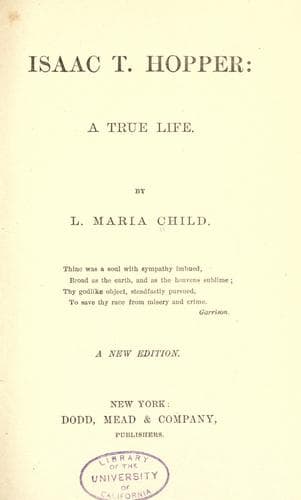
Fugitive slaves -- United States; Hopper, Isaac T. (Isaac Tatem), 1771-1852
The impassive Quaker stood perfectly still, and pointing to Abraham
Morris, he again tendered the half dollar, saying, "I want an extract
from thy docket, in the case of this man's wife. Here is the lawful fee
for it. Please give it to me."
This quiet perseverance deprived the excited magistrate of what little
patience he had left. He took the importunate petitioner by the
shoulders, pushed him into the street, and shut the door.
Friend Hopper then applied to Jacob Rush, President of the Court of
Common Pleas for a writ of _habeas corpus._ The woman was brought before
him, and when he had heard the particulars of the case, and examined her
deed of manumission, he immediately discharged her, to the great joy of
herself and husband.
Friend Hopper thought it might be a useful lesson for Mr. Bussier to
learn that his "little brief authority" had boundaries which could not
be passed with impunity. He accordingly had him indicted for assault
and battery. He and his political friends were a good deal ashamed of
his conduct, and finally, after many delays in bringing on the trial,
and various attempts to hush up the matter, Mr. Bussier called upon
Friend Hopper to say that he deeply regretted the course he had pursued.
His apology was readily accepted, and the case dismissed; he agreeing to
pay the costs.
THE SLAVE MOTHER.
Gassy was slave to a merchant in Baltimore, by the name of Claggett. She
had reason to believe that her master was about to sell her to a
speculator, who was making up a coffle for the markets of the far South.
The terror felt in view of such a prospect can be understood by slaves
only. She resolved to escape; and watching a favorable opportunity, she
succeeded in reaching the neighborhood of Haddonfield, New Jersey. There
she obtained service in a very respectable family. She was honest,
steady, and industrious, and made many friends by her cheerful, obliging
manners. But her heart was never at rest; for she had left in Baltimore
a babe little more than a year old. She had not belonged to an unusually
severe master; but she had experienced quite enough of the sufferings of
slavery to dread it for her child. Her thoughts dwelt so much on this
painful subject, that her naturally cheerful character became extremely
saddened. She at last determined to make a bold effort to save her
little one from the liability of being sold, like a calf or pig in the
shambles. She went to see Isaac T. Hopper and communicated to him her
plan. He tried to dissuade her; for he considered the project extremely
dangerous, and well nigh hopeless. But the mother's heart yearned for
her babe, and the incessant longing stimulated her courage to incur all
hazards. To Baltimore she went; her pulses throbbing hard and fast, with
the double excitement of hope and fear. She arrived safely, and went
directly to the house of a colored family, old friends of hers, in whom
she could confide with perfect safety. To her great joy, she found that
Public-domain text, read in full here on John Shaqi.
Reviews
Reviews
No reviews yet
Be the first to share your thoughts on this work.
Elsewhere in the archive
Join the Discussion
Join the discussion
Sign in to leave a comment or review.
Sign InorCreate an account