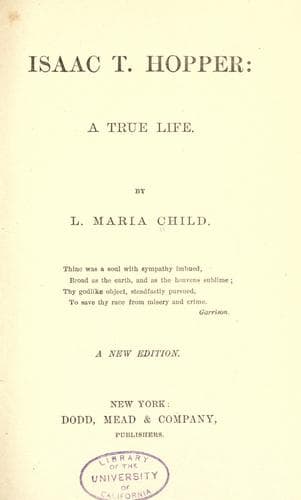
Fugitive slaves -- United States; Hopper, Isaac T. (Isaac Tatem), 1771-1852
The proposed terms were accepted, and the money promptly paid by the
slave from his own earnings. But when Mr. Sergeant proposed that the
suits for assault and battery should be withdrawn, Friend Hopper
replied, "I have no authority to dismiss them."
"They will be dismissed if you advise it," rejoined the lawyer; "and if
you will promise to do it, I shall be perfectly satisfied."
"These colored people have been very badly treated," answered Friend
Hopper. "If the aggressor wants to settle the affair, he had better go
to them and offer some equivalent for the trouble he has given."
The lawyer replied, "When he agreed to manumit the man for one hundred
and fifty dollars, he expected these suits would be dismissed, of
course, as a part of the bargain. What sum do you think these people
will take to withdraw them?"
Friend Hopper said he thought they would do it for one hundred and fifty
dollars.
"I will pay it," replied Mr. Sergeant; "for Colonel Ridgeley is very
anxious to return home."
Thus the money paid for the deed of manumission was returned. Forty
dollars were distributed among the colored people, to repay the damage
done to their property. After some trifling incidental expenses had been
deducted, the remainder was returned to the emancipated slave; who thus
obtained his freedom for about fifty dollars, instead of the sum
originally offered.
STOP THIEF!
About the year 1826, a Marylander, by the name of Solomon Low, arrested
a fugitive slave in Philadelphia, and took him to the office of an
alderman to obtain the necessary authority for carrying him back into
bondage. Finding the magistrate gone to dinner, they placed the colored
man in the entry, while Mr. Low and his companions guarded the door.
Some of the colored people soon informed Isaac T. Hopper of these
circumstances, and he hastened to the office. Observing the state of
things there, he concluded it would be no difficult matter to give the
colored man a chance to escape. He stepped up to the men at the door,
and demanded in a peremptory manner by what authority they were holding
that man in duress. Mr. Low replied, "He is my slave."
"This is strange conduct," rejoined Friend Hopper. "Who can tell whether
he is thy slave or not? What proof is there that you are not a band of
kidnappers? Dost thou suppose the laws of Pennsylvania tolerate such
proceedings?"
These charges arrested the attention of Mr. Low and his companions, who
turned round to answer the speaker. The slave, seeing their backs toward
him for an instant, seized that opportunity to rush out; and he had run
two or three rods before they missed him. They immediately raised the
cry of "Stop Thief! Stop Thief!" An Irishman, who joined in the
pursuit, arrested the fugitive and brought him back to his master.
Friend Hopper remonstrated with him; saying, "The man is not a thief.
They claim him for a slave, and he was running for liberty. How wouldst
thou like to be made a slave?"
Public-domain text, read in full here on John Shaqi.
Reviews
Reviews
No reviews yet
Be the first to share your thoughts on this work.
Elsewhere in the archive
Join the Discussion
Join the discussion
Sign in to leave a comment or review.
Sign InorCreate an account