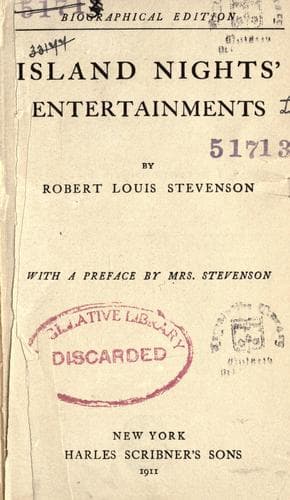
Island Nights' EntertainmentsStevenson, Robert Louis
General
Island Nights' Entertainments
Stevenson, Robert Louis
Islands of the Pacific -- Fiction; Short stories
However, there’s no use crying over spilt milk. It was done now, and
couldn’t be undone. All I could do was to get what was left of it, and
my new stuff (my own choice) in order, to go round and get after the
rats and cockroaches, and to fix up that store regular Sydney style. A
fine show I made of it; and the third morning when I had lit my pipe
and stood in the door-way and looked in, and turned and looked far up
the mountain and saw the cocoanuts waving and posted up the tons of
copra, and over the village green and saw the island dandies and
reckoned up the yards of print they wanted for their kilts and dresses,
I felt as if I was in the right place to make a fortune, and go home
again and start a public-house. There was I, sitting in that verandah,
in as handsome a piece of scenery as you could find, a splendid sun,
and a fine fresh healthy trade that stirred up a man’s blood like
sea-bathing; and the whole thing was clean gone from me, and I was
dreaming England, which is, after all, a nasty, cold, muddy hole, with
not enough light to see to read by; and dreaming the looks of my
public, by a cant of a broad high-road like an avenue, and with the
sign on a green tree.
So much for the morning, but the day passed and the devil anyone looked
near me, and from all I knew of natives in other islands I thought this
strange. People laughed a little at our firm and their fine stations,
and at this station of Falesá in particular; all the copra in the
district wouldn’t pay for it (I had heard them say) in fifty years,
which I supposed was an exaggeration. But when the day went, and no
business came at all, I began to get downhearted; and, about three in
the afternoon, I went out for a stroll to cheer me up. On the green I
saw a white man coming with a cassock on, by which and by the face of
him I knew he was a priest. He was a good-natured old soul to look at,
gone a little grizzled, and so dirty you could have written with him on
a piece of paper.
“Good day, sir,” said I.
He answered me eagerly in native.
“Don’t you speak any English?” said I.
“French,” says he.
“Well,” said I, “I’m sorry, but I can’t do anything there.”
He tried me awhile in the French, and then again in native, which he
seemed to think was the best chance. I made out he was after more than
passing the time of day with me, but had something to communicate, and
I listened the harder. I heard the names of Adams and Case and of
Randall—Randall the oftenest—and the word “poison,” or something like
it, and a native word that he said very often. I went home, repeating
it to myself.
“What does fussy-ocky mean?” I asked of Uma, for that was as near as I
could come to it.
“Make dead,” said she.
“The devil it does!” says I. “Did ever you hear that Case had poisoned
Johnnie Adams?”
“Every man he savvy that,” says Uma, scornful-like. “Give him white
sand—bad sand. He got the bottle still. Suppose he give you gin, you no
take him.”
Public-domain text, read in full here on John Shaqi.
Reviews
Reviews
No reviews yet
Be the first to share your thoughts on this work.
Join the Discussion
Join the discussion
Sign in to leave a comment or review.
Sign InorCreate an account