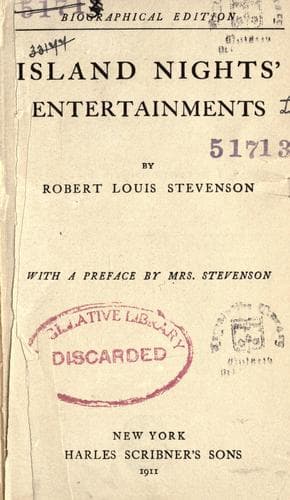
Island Nights' EntertainmentsStevenson, Robert Louis
General
Island Nights' Entertainments
Stevenson, Robert Louis
Islands of the Pacific -- Fiction; Short stories
one strange thing—that he had made a will, like a Christian, and the
widow got the lot: all his, they said, and all Black Jack’s, and the
most of Billy Randall’s in the bargain, for it was Case that kept the
books. So she went off home in the schooner _Manu’a_, and does the lady
to this day in her own place.
But of all this on that first morning I knew no more than a fly. Case
used me like a gentleman and like a friend, made me welcome to Falesá,
and put his services at my disposal, which was the more helpful from my
ignorance of the native. All the better part of the day we sat drinking
better acquaintance in the cabin, and I never heard a man talk more to
the point. There was no smarter trader, and none dodgier, in the
islands. I thought Falesá seemed to be the right kind of a place; and
the more I drank the lighter my heart. Our last trader had fled the
place at half an hour’s notice, taking a chance passage in a labour
ship from up west. The captain, when he came, had found the station
closed, the keys left with the native pastor, and a letter from the
runaway, confessing he was fairly frightened of his life. Since then
the firm had not been represented, and of course there was no cargo.
The wind, besides, was fair, the captain hoped he could make his next
island by dawn, with a good tide, and the business of landing my trade
was gone about lively. There was no call for me to fool with it, Case
said; nobody would touch my things, everyone was honest in Falesá, only
about chickens or an odd knife or an odd stick of tobacco; and the best
I could do was to sit quiet till the vessel left, then come straight to
his house, see old Captain Randall, the father of the beach, take
pot-luck, and go home to sleep when it got dark. So it was high noon,
and the schooner was under way before I set my foot on shore at Falesá.
I had a glass or two on board; I was just off a long cruise, and the
ground heaved under me like a ship’s deck. The world was like all new
painted; my foot went along to music; Falesá might have been Fiddler’s
Green, if there is such a place, and more’s the pity if there isn’t! It
was good to foot the grass, to look aloft at the green mountains, to
see the men with their green wreaths and the women in their bright
dresses, red and blue. On we went, in the strong sun and the cool
shadow, liking both; and all the children in the town came trotting
after with their shaven heads and their brown bodies, and raising a
thin kind of a cheer in our wake, like crowing poultry.
“By-the-bye,” says Case, “we must get you a wife.”
“That’s so,” said I; “I had forgotten.”
There was a crowd of girls about us, and I pulled myself up and looked
among them like a Bashaw. They were all dressed out for the sake of the
ship being in; and the women of Falesá are a handsome lot to see. If
they have a fault, they are a trifle broad in the beam; and I was just
thinking so when Case touched me.
“That’s pretty,” says he.
Public-domain text, read in full here on John Shaqi.
Reviews
Reviews
No reviews yet
Be the first to share your thoughts on this work.
Join the Discussion
Join the discussion
Sign in to leave a comment or review.
Sign InorCreate an account