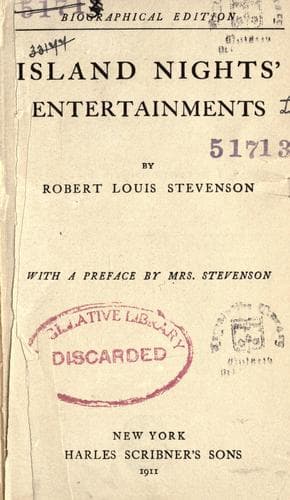
Island Nights' EntertainmentsStevenson, Robert Louis
General
Island Nights' Entertainments
Stevenson, Robert Louis
Islands of the Pacific -- Fiction; Short stories
And I began to walk towards him, quite slow, and my hands down; only
there was trouble in my eye, if anybody took the pains to look.
“You’re a low, obstropulous fellow, Sah,” says he.
“You bet!” says I.
By that time he thought I was about as near as convenient, and lit out
so it would have done your heart good to see him travel. And that was
all I saw of that precious gang until what I am about to tell you.
It was one of my chief employments these days to go pot-hunting in the
woods, which I found (as Case had told me) very rich in game. I have
spoken of the cape which shut up the village and my station from the
east. A path went about the end of it, and led into the next bay. A
strong wind blew here daily, and as the line of the barrier reef
stopped at the end of the cape, a heavy surf ran on the shores of the
bay. A little cliffy hill cut the valley in two parts, and stood close
on the beach; and at high water the sea broke right on the face of it,
so that all passage was stopped. Woody mountains hemmed the place all
round; the barrier to the east was particularly steep and leafy, the
lower parts of it, along the sea, falling in sheer black cliffs
streaked with cinnabar; the upper part lumpy with the tops of the great
trees. Some of the trees were bright green, and some red, and the sand
of the beach as black as your shoes. Many birds hovered round the bay,
some of them snow-white; and the flying-fox (or vampire) flew there in
broad daylight, gnashing its teeth.
For a long while I came as far as this shooting, and went no farther.
There was no sign of any path beyond, and the cocoa-palms in the front
of the foot of the valley were the last this way. For the whole “eye”
of the island, as natives call the windward end, lay desert. From
Falesá round about to Papa-malulu, there was neither house, nor man,
nor planted fruit-tree; and the reef being mostly absent, and the
shores bluff, the sea beat direct among crags, and there was scarce a
landing-place.
I should tell you that after I began to go in the woods, although no
one offered to come near my store, I found people willing enough to
pass the time of day with me where nobody could see them; and as I had
begun to pick up native, and most of them had a word or two of English,
I began to hold little odds and ends of conversation, not to much
purpose to be sure, but they took off the worst of the feeling, for
it’s a miserable thing to be made a leper of.
It chanced one day towards the end of the month, that I was sitting in
this bay in the edge of the bush, looking east, with a Kanaka. I had
given him a fill of tobacco, and we were making out to talk as best we
could; indeed, he had more English than most.
I asked him if there was no road going eastward.
“One time one road,” said he. “Now he dead.”
“Nobody he go there?” I asked.
“No good,” said he. “Too much devil he stop there.”
“Oho!” says I, “got-um plenty devil, that bush?”
Public-domain text, read in full here on John Shaqi.
Reviews
Reviews
No reviews yet
Be the first to share your thoughts on this work.
Join the Discussion
Join the discussion
Sign in to leave a comment or review.
Sign InorCreate an account