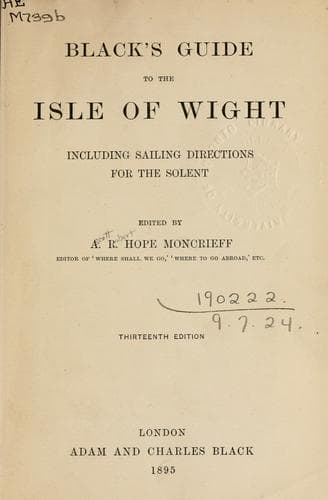
Isle of WightMoncrieff, A. R. Hope (Ascott Robert Hope)
History
Isle of Wight
Moncrieff, A. R. Hope (Ascott Robert Hope)
Isle of Wight (England) -- Description and travel
We need not cast about for the spot at which to make our landing on the
shores of Wight. Lying opposite Portsmouth, with a crossing of
half-an-hour or so, Ryde is the chief gateway of the Island and knot of
its railways to every part, Cowes being more in touch with Southampton,
and Yarmouth at the west end coming closest to the mainland port of
Lymington. With its suburbs and dependencies, Ryde is considerably the
largest place, having outgrown Newport, the titular capital, by a
population largely made up of retired veterans, families of officers on
service, and other select society such as one finds thickly settled at
Southsea, across the Solent. So much one can guess from the look of the
brick villas that spread over the swelling heights of Ryde’s background,
and of the smart shops in and about its Union Street, while an unusual
proportion of hotels and refreshment rooms hint at influx of transient
visitors both from the classes and the masses.
A century ago, this could be described in a local guide-book as a “place
of some consequence.” Only since then has Ryde become the goodly town
we now see, yet it is no mushroom resort, but old enough to have been
burned by French assailants under Richard II. The sheltered anchorage
behind the Isle of Wight was once too well known to wind-bound
travellers, who might have to fret here for weeks or months, as Leigh
Hunt, on his voyage to Italy, spent half a year at Plymouth. So
Fielding, sailing to die at Lisbon, was detained at Ryde, which seems
then to have been little more than a hamlet. No tea could be got there;
it had a butcher, but he was not “killing”; and though the inn at which
the travellers put up could supply a long bill, its other accommodations
were such that they preferred to take their dinner in the barn. The
landing of a helpless invalid proved a trying adventure where, “between
the sea and the shore, there was at low water an impassable gulf, if I
may so call it, of deep mud, which could neither be traversed by walking
nor swimming, so that for near one half of the twenty-four hours, Ryde
was inaccessible by friend or foe.” In spite of such disadvantages, the
dying novelist has nothing but good to say of it, once he had got over
its moat of mud.
This pleasant village is situated on a gentle ascent from the
water, whence it affords that charming prospect I have above
described. Its soil is a gravel, which, assisted with its
declivity, preserves it always so dry, that immediately after the
most violent rain, a fine lady may walk without wetting her silken
shoes. The fertility of the place is apparent from its
extraordinary verdure, and it is so shaded with large and
flourishing elms, that its narrow lanes are a
[Illustration: RYDE--MOONRISE]
Public-domain text, read in full here on John Shaqi.
Reviews
Reviews
No reviews yet
Be the first to share your thoughts on this work.
Join the Discussion
Join the discussion
Sign in to leave a comment or review.
Sign InorCreate an account