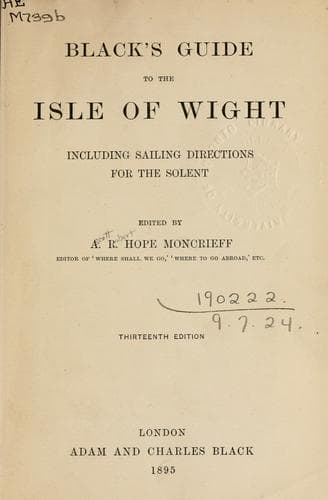
Isle of WightMoncrieff, A. R. Hope (Ascott Robert Hope)
History
Isle of Wight
Moncrieff, A. R. Hope (Ascott Robert Hope)
Isle of Wight (England) -- Description and travel
Seaview, indeed, was first Seagrove before it became a flourishing
family bathing-place, with the unusual setting of woods so close down to
the water’s edge that one may lie in a boat and hear the nightingale
almost overhead; but these groves tantalise the landlubber by a crop of
forbidding notices to trespassers. It has a chain pier of its own, and a
regular service of steamboats from Southsea, that run on to Bembridge.
This pier, with the hotel behind, splits the place into two separate
sections, marked by their architecture as belonging to different strata
of pleasure-seeking. The part nearer Ryde is the true old Seaview of
wandering rows, bow-windowed lodging-houses, and modest refreshment
rooms. On the east side of the bay has sprung up a newer, smarter,
redder bit of esplanade, making a pretty contrast to its dark green
background. A private road leads to this end, which, else, at high tide
is cut off, so that the butcher or greengrocer may be seen delivering
his wares by boat in quite Venetian manner. There are sands for
children, and rocks for scrambling, and a shallow beach for launching
canoes on these safe waters, where the red sails of the Bembridge Yacht
Club make dots of colour, as do the tents here taking the place of
bathing-machines. Another peculiar feature is the diving-boards anchored
out at sea, since the tide, creeping up to the Esplanade garden gates,
woos paddlers rather than swimmers. Seaview, in short, holds itself
something out of the common in the way of bathing-places, dealing with
strangers rather in the wholesale way of house-letting than the retail
trade of apartments.
Beyond the broken point, where one seems to catch Nature in her
workshop, kneading clay into firmer forms, a rough walk along the shore
of Priory Bay leads on to St Helen’s, reached inland by the road through
Nettlestone Green. Once clear of houses, we plunge among the rank
greenery of the Island, too much monopolised here by the grounds of the
Priory, which preserves the name of a colony of monks swarmed over from
France to St Helen’s in early Plantagenet days. This was one of the
properties bought by Emmanuel Badd, who, _teste_ Sir John Oglander,
began life as a poor shoemaker’s apprentice at Newport, “but by God’s
blessinge and ye loss of 5 wyfes, he grewe very ritch,” rose to be High
Sheriff of Hants, and was buried under an epitaph in Jacobean taste,
ending
So good a Bad doth this same grave contain,
Would all like Bad were that with us remain!
But at St Helen’s we have rounded the corner of the Island, which we may
now survey from another line of operations.
NEWPORT
Public-domain text, read in full here on John Shaqi.
Reviews
Reviews
No reviews yet
Be the first to share your thoughts on this work.
Join the Discussion
Join the discussion
Sign in to leave a comment or review.
Sign InorCreate an account