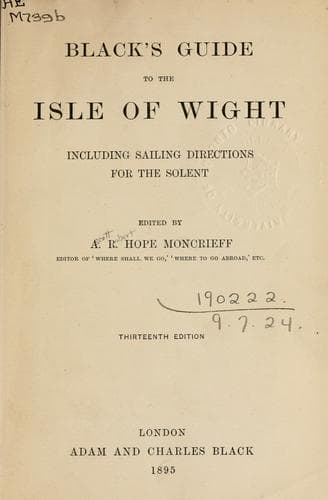
Isle of WightMoncrieff, A. R. Hope (Ascott Robert Hope)
History
Isle of Wight
Moncrieff, A. R. Hope (Ascott Robert Hope)
Isle of Wight (England) -- Description and travel
Bembridge itself, linked to St Helens by a ferry boat, nestles very
prettily on the wooded point opposite. The nucleus of nautically named
inns and cottages is much overlaid by hotel and lodging-house
accommodation, and by villas whose owners declare Bembridge to be the
Island’s pleasantest spot. One of its chief attractions, after golf, is
the view of shipping in the Solent mouth; but it has some pretty spots
on land, such as the avenue running inland from the bathing beach. To
the south it is sheltered by the Foreland, the most easterly point, over
which we may hold by mounting lanes, or take a rough path round the
shore, tide permitting, that has also to be considered in boating about
the dangerous Bembridge Ledges roughening the sea at low water.
Thus we pass on to the curve of Whitecliff Bay, where the chalk of the
Downs is broken by an expanse of Eocene beds, making for the geologist a
foretaste
[Illustration: SANDOWN BAY]
of that more glowing transformation scene shown in Alum Bay at the
Island’s western end. The Culver Cliffs at this end are protected by a
fort which has masked the Hermit’s Hole, a cave once used by smugglers.
On the other side of Bembridge is a small fortress, now so far behind
the times that it was lately advertised as suitable for a private
residence or an hotel.
Beyond Whitecliff Bay, the cliffs curve into the block of Bembridge
Down, crowned by a modern fort that has usurped the originally more
conspicuous site of Lord Yarborough’s monument, now neighboured by a
Marconi Telegraph Station. On the southern slope are the tiny Norman
Church and decayed manor-house of Yaverland, which makes a scene in the
_Dairyman’s Daughter_. Here we have come round to Sandown Bay, the
largest and openest in the Island, reached byroad and rail from Brading
through the gap at Yarbridge.
Sandown stands in a break of the cliffs, behind the centre of its bay,
compared of course to the Bay of Naples by those who never saw Vesuvius.
With its hotels, rows of smart lodging-houses, batteries of
bathing-machines, esplanade, arcade, and other very modern features,
this seems one of the most growing places in the Island; and I trust
Sandown will not take it amiss to be described as perhaps the most
commonplace resort here, or at least the most like the ordinary
Saturday-to-Monday. Its strong point is wide, firm sands for children,
and, on a common behind the town, excellent golf-links for their
elders, about the height known as “Majuba Hill,” the views from which
are complained of by votaries as interfering with strict attention to
their game. The summer season of this bathing-place is so prosperous
that some day its esplanade and Shanklin’s may stretch out to meet along
the couple of miles of cliff walk separating them. As link between them
springs up Lake, with its sumptuous “Home of Rest,” and its headquarters
of Isle of Wight cricket, behind the cliff descent at Littlestairs.
Public-domain text, read in full here on John Shaqi.
Reviews
Reviews
No reviews yet
Be the first to share your thoughts on this work.
Join the Discussion
Join the discussion
Sign in to leave a comment or review.
Sign InorCreate an account