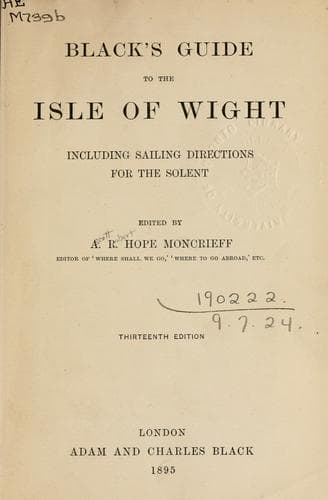
Isle of WightMoncrieff, A. R. Hope (Ascott Robert Hope)
History
Isle of Wight
Moncrieff, A. R. Hope (Ascott Robert Hope)
Isle of Wight (England) -- Description and travel
His first notable _coup_ in England seems to have been during the
Franco-Prussian War, when he flew at such high game as the very Lord
Mayor. A French town had been burned by the Prussians. While this
disaster was still fresh on our news sheets, there burst into the
Mansion House a voluble gentleman professing to be the mayor of that
town, come to throw himself on the generosity of the great English
nation. Our sympathetic Lord Mayor handed out a thousand pounds; and it
was whispered at the time that this plausible guest carried off also the
heart of his lordship’s daughter. The clever trick ended in detection,
arrest, and two years’ imprisonment; then by way of varying the monotony
of Newgate, Benson tried to set fire to his cell, but succeeded only in
burning himself about the spine, so as to be henceforth a helpless
cripple. There were some who surmised that he made the most of this
injury as helping out his disguise of deceit; but I never saw his slight
figure unless as recumbent on a couch, or carried like a child in the
arms of a big Frenchman, who passed as his valet, being really one of
the swindling gang of which Benson was the brain. His crippled state was
put down to a railway accident.
After his release from Newgate comes a period of obscurity, from which
he emerges about 1875 as living in some style at Shanklin, with a London
_pied à terre_ in Cavendish Square, a brougham, and everything genteel
about him. It was at this time I made his acquaintance. He then passed
under the name of Yonge, with some explanation which I forget; but he
confided to me and to others how he was really the Count de Montague, a
Frenchman engaged in conspiring for the Empire, business that was to
account for the seclusion in which he lived. This struck me as dubious:
in those days, before dynamite outrages, one could conspire at the
pitch of one’s voice in the middle of Piccadilly without anyone caring
to interfere. Moreover, in writing to me, he signed himself _De
Montagu_, whereas, for a more favoured friend, he decorated the name
with a final _e_. It took little Sherlock Holmes’ faculty to detect that
a French nobleman ought to know how to spell his own name; but I am glad
to say that from my first sight of the “Count,” I distrusted a gentleman
whose dress and manners seemed too fine to be true. He never deceived me
by his pretensions; and his overdone elegance served to set others on
their guard. Indeed, like Joseph Andrews, he might have passed for a
nobleman with one who had not seen many noblemen.
Public-domain text, read in full here on John Shaqi.
Reviews
Reviews
No reviews yet
Be the first to share your thoughts on this work.
Join the Discussion
Join the discussion
Sign in to leave a comment or review.
Sign InorCreate an account