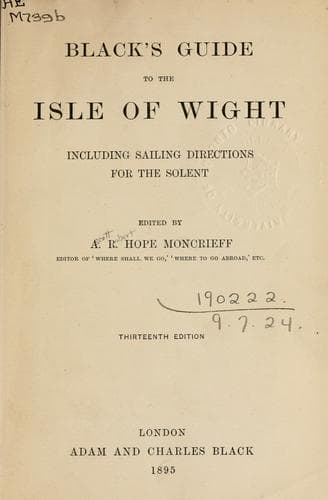
Isle of WightMoncrieff, A. R. Hope (Ascott Robert Hope)
History
Isle of Wight
Moncrieff, A. R. Hope (Ascott Robert Hope)
Isle of Wight (England) -- Description and travel
Here a narrow strip of shore lies for miles walled in to the north by a
steep bank several hundred feet high, sometimes presenting a rugged face
of sandstone cliff, elsewhere rising in the turf swell of chalk downs.
But the bastions of rock thus displayed rest upon a treacherous
foundation of gault clay, expressively known as the “Blue slipper,”
which, saturated with water, has given way so as to cause repeated
landslides and falls of the super-incumbent strata, tumbling the lower
slopes into a broken chaos of terraces and knolls, dotted with boulders
of chalk and sandstone. This ruin of nature has long been overgrown by
rich greenery, mantling its asperities, all the more since the charms
and mildness of the situation go to making it a much trimmed wilderness,
populated with villages and villas that turn the Undercliff into one
great garden of choice and luxuriant vegetation.
The capital of the Undercliff is Ventnor, whose dependencies and
outposts straggle almost all along this sheltered coast-strip. Now the
most beautifully placed and the most widely admired town in the Island,
it has risen to such note within the memory of men still living. A
century ago Sir H. Englefield gives it a word as “a neat hamlet,” while
guide-books of his day do not even name it between the older villages of
St Lawrence and Bonchurch, that on either side wing its body of terraces
and zigzag streets. Its history seems illustrated in the old “Crab and
Lobster” Inn, from a modest haunt of fishermen developed into a spacious
hotel, and still more plainly in the monuments of so many a young life
close packed about its nineteenth century churches. It was Sir James
Clarke, an esteemed physician of our great-grandfathers’ day, who dubbed
Ventnor an English Madeira, and brought it into medical repute as a
rival of Torquay, both of them disputing the honour of having the
mildest winter climate in England, which probably belongs rather to the
Cornish coast, or to other claimants still wanting a _vates sacer_, that
is, a London doctor to give them bold advertisement.
Public-domain text, read in full here on John Shaqi.
Reviews
Reviews
No reviews yet
Be the first to share your thoughts on this work.
Join the Discussion
Join the discussion
Sign in to leave a comment or review.
Sign InorCreate an account