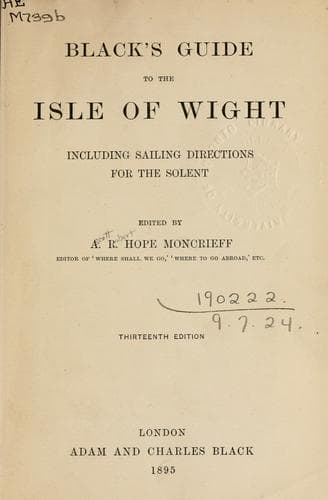
Isle of WightMoncrieff, A. R. Hope (Ascott Robert Hope)
History
Isle of Wight
Moncrieff, A. R. Hope (Ascott Robert Hope)
Isle of Wight (England) -- Description and travel
This line of cliffs may indeed remind us of the Trossachs, with one side
opened out to the sun and a richer vegetation at its base. Hawthorns,
elders, and other bushes grow here to a huge height, dappling the green
of the woods with their blossoms. Myrtle and other semi-tropical plants
flourish hardily; everywhere there are flowers prodigal as weeds,
notably the red Valerian flourishing on walls and broken edges. Huge
boulders are half hidden in ivy, heaps of old ruins are buried in almost
impassable thickets. It is hard to say when the huge bank of greenery is
most beautiful--whether in spring with all its blossoms and tender buds;
or in summer wearing its full glory of leafage; or again in autumn
brilliant with changing tints and spangled by bright berries: even in
winter there are evergreens enough to make us forget the cold winds
banished from this cosy nook. The one blot on such a paradise seems the
many notices to trespassers, warning that its most tempting nooks are
“private,” or the still more ominous placards of “valuable building land
to let on lease.”
The Bonchurch Landslip must be traversed on foot. On the other side of
Ventnor, a good road winds up and down beneath the inland heights, from
the edge of which one better sees how many houses and gardens are
hidden away here in their own greenery. Other aspects are presented from
a path rising and falling along the broken cliffs of the shore. The
road, in fine weather, will be astir with coaches, brakes, and other
wheels making for Blackgang Chine, that renowned goal of excursions from
all over the Island. Beyond Steephill Castle, it leads through St
Lawrence, the western, as Bonchurch is the eastern wing of Ventnor.
St Lawrence, known to guide-books that used to pass Ventnor Cove without
a word, has another of the smallest churches in England, now replaced by
a new one. The old church, till slightly enlarged by Lord Yarborough,
measured twenty feet by twelve under a roof which must have obliged a
tall knight to doff his helmet. Its saint, like St Boniface, gave his
name to a well now enclosed under a Gothic arch. But the great
institution of the parish, standing in a long terrace by the roadside,
is the Hospital for Consumption, which Ventnor people insist on as being
at St Lawrence, just as Woking pushes off the honour of the Brookwood
Cemetery. There was a time when this model hospital made an
advertisement for Ventnor; now new notions as to germ-infection tend to
scare away more profitable guests than its patients, who might be
expected to fall off under new theories of treatment for consumption,
but the building has had a recent addition in memory of Prince Henry of
Battenberg.
Public-domain text, read in full here on John Shaqi.
Reviews
Reviews
No reviews yet
Be the first to share your thoughts on this work.
Join the Discussion
Join the discussion
Sign in to leave a comment or review.
Sign InorCreate an account