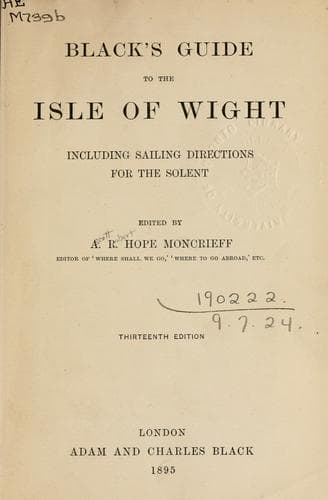
Isle of WightMoncrieff, A. R. Hope (Ascott Robert Hope)
History
Isle of Wight
Moncrieff, A. R. Hope (Ascott Robert Hope)
Isle of Wight (England) -- Description and travel
said to have been meant for Louis XIV., but being captured at sea along
with the sculptor, he was forced to fit it with a head of Sir Robert.
This local worthy, Governor of the Island under Charles II., and a
benefactor to the town by embanking its marshy estuary, had a wider
renown as one of our early Nelsons; he is repeatedly mentioned in Pepys’
_Diary_, and his epitaph tells in sounding Latin how, among other
exploits, he more than once beat the Dutch, not always beaten at sea by
Charles’ sailors, how he took from them the colony of _Nova Belgia_, now
better known as New York, and how he captured a cargo of Guinea gold
that was coined into a word of much credit in our language.
The Island boasts at least one other sailor as having earned a place in
our story. There was a poor tailor’s apprentice of Bonchurch who,
according to the legend, ran away to the king’s navy, proved himself in
his first fight worth more than nine men, and rose to be Admiral Sir
Thomas Hopson, knighted by Queen Anne for breaking the boom at Vigo.
These rough coasts have all along nursed a breed of stout sea-dogs, not
always so well employed as in fighting the battles of their country. A
century ago Yarmouth, and indeed all this corner, seems to have been a
nest of amphibian waiters on the tides of fortune, passing as fishermen
plain, but often coloured as smugglers, and proving excellent food for
powder when they could be pressed into the navy blue.
Such proof spirits made boon companions for the eccentric painter
George Morland, when in 1799 he fled from London to escape bailiffs. He
had thus nearly jumped from the frying-pan into the fire, since at
Yarmouth he and his brother were arrested by a party of the Dorset
militia on suspicion of being spies for the French--why else should
strangers be sketching the coast? At Shanklin, the same suspicion fell
upon another artist, whom the fishermen began to pelt from his easel,
but he, being a very fat man, cleared himself by patting his paunch, and
exclaiming, “Does this look like anything French?” There was a spy-fever
all over the Island at that time. In Morland’s case, amid the hoots of a
patriotic populace, the military Dogberries marched off their prisoners
to Newport, where they were discharged by the magistrates only on
condition of making no more sketches. In spite of such prohibition, some
of Morland’s best work represents the Freshwater cliffs and the fishing
folk of this coast.
Public-domain text, read in full here on John Shaqi.
Reviews
Reviews
No reviews yet
Be the first to share your thoughts on this work.
Elsewhere in the archive
Join the Discussion
Join the discussion
Sign in to leave a comment or review.
Sign InorCreate an account