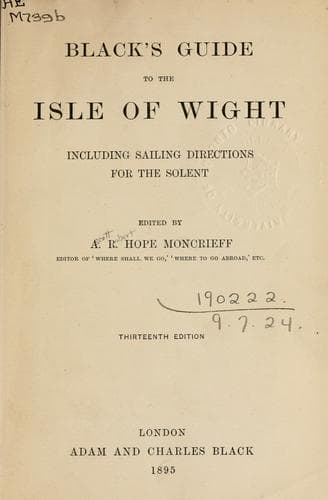
Isle of WightMoncrieff, A. R. Hope (Ascott Robert Hope)
History
Isle of Wight
Moncrieff, A. R. Hope (Ascott Robert Hope)
Isle of Wight (England) -- Description and travel
Yarmouth gives itself few seaside airs; yet one has seen bathing-places
with no more to build on. There is a stretch of sand where a few
bathing-machines are unlimbered; and at low tide the smell of seaweed
and salt mud might be considered medicinal. The Pier Hotel (the
ex-“George”) has recently enlarged itself to invite custom; and on the
other side of the pier the Solent Yacht Club makes a showy patch upon a
general aspect of well-worn old-fashionedness. If one yearn for a
thicker mixture of up-to-date buildings, one has only to take the two
or three miles’ walk, or few minutes’ railway run to Freshwater.
To the east, the Bouldnor estate has been trying to blossom into a red
brick resort upon its wooded shore fringed with sand. By the low cliffs
on this side we pass on towards the Hamstead Ledges, mines of fossils
wealth, which I have heard a British Association President declare to be
the most interesting part of the Island; but the general public takes
quite an opposite view. The northern shore, with its muddy flats and
crumbling banks, has no attraction for the many, till the sands of
Gurnard Bay bring us round to the far stretched esplanade of Cowes.
Behind the coast, Parkhurst Forest once extended from Yarmouth to Cowes,
where the country is still dotted with its fragments in woods, copses,
and straggling hedgerows. Here, between the Downs and the Solent, runs
the railway to Newport, keeping well back in the green plain, with more
apparent regard for economy of line than for the convenience of the
villages it serves on either hand. Its course, indeed, is soon turned
inland by the Newton River, whose crops are raised from salterns and
oyster-beds, across which the railway gets glimpses of the sea two or
three miles away.
Among the branching creeks of this shallow inlet may be sought out
Newton, now a mere hamlet, but, in the teeth of its name, boasting
itself the oldest borough in the Island, which till not so long ago
returned two members of Parliament, among them such celebrities as
Churchill, Duke of Marlborough, and George Canning. Though the place has
a tiny, tumbledown Town Hall, it was only in the last century that it
got a church of its own. But its now larger neighbour Shalfleet, nearer
the railway, has one of the most notable churches on the Island, with a
massive Norman tower and other relics, such as the rude carving over the
north door, the subject of which makes a riddle for antiquaries.
Public-domain text, read in full here on John Shaqi.
Reviews
Reviews
No reviews yet
Be the first to share your thoughts on this work.
Elsewhere in the archive
Join the Discussion
Join the discussion
Sign in to leave a comment or review.
Sign InorCreate an account