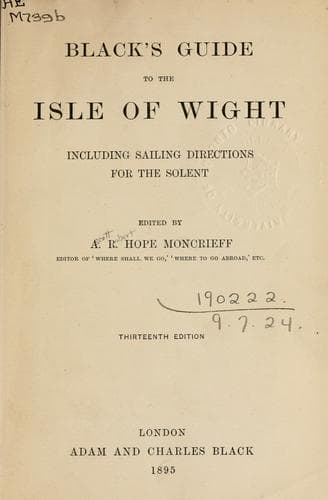
Isle of WightMoncrieff, A. R. Hope (Ascott Robert Hope)
History
Isle of Wight
Moncrieff, A. R. Hope (Ascott Robert Hope)
Isle of Wight (England) -- Description and travel
The latest scene for fiction set in the Isle of Wight--_All Moonshine_,
by Richard Whiteing--is no photograph of actual society like that just
reduced, but a most imaginative romance, not to say a wild nightmare
inspired by the dangers of over-population, and based on the statistical
claim quoted in my first chapter, that the world’s eighteen hundred
millions or so could all find room to meet in this Island. The author,
falling asleep at Ventnor, dreams of such a universal rendezvous as
coming about in the form of astral bodies from all ends of the earth,
when some very strange things happen among the unsubstantial multitude.
At one moment it seems as if the ghostly armies of England and Germany
were about to close here in a lurid Armageddon; but they are fain to
fraternise before the general peril of an earthquake announced at Shide
as threatening to crack the globe and overwhelm civilisation in waves of
fire let loose from hell. The dreamer awakes to find the world what it
is, with nations and classes seeking to fatten on their neighbours’
poverty, kings and statesmen watching each other’s armaments in mutual
suspicion, priests hoisting flags on their churches in exultation over
the slaughter of fellow-Christians, and only an unpractical poet or
romancer to cry here and there--
Ah! when shall all men’s good
Be each man’s rule, and universal peace
Lie like a shaft of light across the land,
And like a lane of beams athwart the sea,
Thro’ all the circle of the golden year.
[Illustration: CALBOURNE]
COWES
We now come to one of the most important places in the Island, a place
that holds up its double head for second to none in the way of dignity
and fashion, though it began life as two small castles built by Henry
VIII. at the Medina’s mouth to protect the harbour of Newport.
The two great Cows that in loud thunder roar,
This on the eastern, that the western shore,
Where Newport enters stately Wight.
“I knew when there was not above three or four houses at Cowes,” says
Sir John Oglander, who yet had counted three hundred ships at anchor
there; “and I was and am persuaded that if our wars and troubles had not
unfortunately happened, it would have grown as famous as Newport.”
Another scourge of the Island in his time was the activity of lawyers to
stir up strife, whereas the first attorney who ventured himself here had
been ignominiously charivaried out of this Arcadian scene by order of
the Governor. But it might be, he admits, that lawyers were no more to
blame than the absence of ships of war, once such good customers for
the Islanders’ produce. “Now peace and law hath beggared us all, so
that within my memory many of the gentlemen and almost all the yeomanry
are undone.” One observes the distinction drawn by this rule of thumb
economist between the ruinous effects of civil war and the profitable
accidents of helping to ruin another country.
Public-domain text, read in full here on John Shaqi.
Reviews
Reviews
No reviews yet
Be the first to share your thoughts on this work.
Elsewhere in the archive
Join the Discussion
Join the discussion
Sign in to leave a comment or review.
Sign InorCreate an account