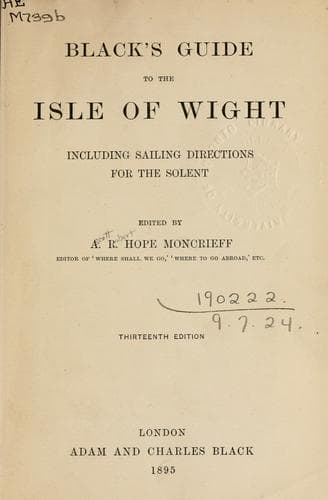
Isle of WightMoncrieff, A. R. Hope (Ascott Robert Hope)
History
Isle of Wight
Moncrieff, A. R. Hope (Ascott Robert Hope)
Isle of Wight (England) -- Description and travel
It is easy to understand how Cowes came to be the Tilbury and Gravesend
of Newport, then by and by to supplant it as the Island’s chief port. In
the days of small vessels, such a harbour as Newport offers was roomy
and accessible enough, while it had the advantage of being more out of
the way of hostile attack. London, Glasgow, Newcastle, Exeter, Bristol
are only a few examples of great ports lying some way up navigable
rivers; then on the larger scale of the world, one at once thinks of
Calcutta, Canton, Montreal, New Orleans, Rosario, and so on. Some of
these inland havens have kept their commercial position only by pains
and cost hardly worth while to save half-a-dozen miles of water
carriage; so, as ships grew too big for the tiny wharves of Newport,
they would unload at the mouth of the river that makes the one good
harbour on the Island. Thus Cowes grew apace; and a century ago it bid
fair to be at least the second Wight town, till Ryde took a sudden start
in prosperity. Like Ryde and Yarmouth it throve by victualling the great
war fleets and convoys that often lay wind-bound in the Solent. But
Cowes got a special string to its bow in the ship-building industry
rooted here, then another in its position as headquarters of Solent
yachting; and royal favour went to bring it into fashion. There was a
time when it aspired to be a mere Margate or Sandown, in honour of which
a Georgian poet named Jones is moved to predict--
No more to foreign baths shall Britain roam
But plunge at Cowes and find rich health at home!
To tell the truth, Cowes hardly shines in this capacity. Its bathing is
not everywhere safe in the currents of the Solent; and to pick out a
sandy oasis on the rough beach one must go eastward towards Gurnard Bay.
Nowadays, indeed, the place is so spoilt by the patronage of European
royalties and American millionaires, that it does not much care to lay
itself out for the holiday-making _bourgeois_ and his olive branches.
The straggling town, divided by the Medina, has no particular charm
unless that of a marine flavour. It is far from being so picturesque as
Ventnor, or so imposing as Ryde; and apart from the artificial beauties
of the parks enclosing it, its surroundings are commonplace beside those
of Newport. Its main interest is on the sea-face looking over the
shallow waters of the Solent, beside which East Cowes huddles along a
narrow main street, that winds up and down, in and out, here and there,
making a quaint show of houses old and new, half and half, dwellings
mixed with shops, an unusual proportion of them providing refreshments,
when they do not display such wares as ship’s lanterns, and other
sea-fittings from cordage to carronades. The central point is the
steamboat pier opposite the station; then further west comes the
Victoria Pier with its pavilion, on a scale that shows how little Cowes
cares to cater for your common Saturday to Monday visitor.
Public-domain text, read in full here on John Shaqi.
Reviews
Reviews
No reviews yet
Be the first to share your thoughts on this work.
Elsewhere in the archive
Join the Discussion
Join the discussion
Sign in to leave a comment or review.
Sign InorCreate an account