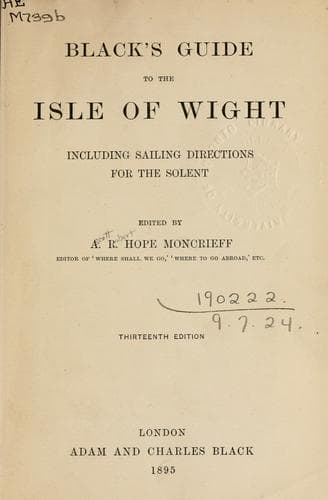
Isle of WightMoncrieff, A. R. Hope (Ascott Robert Hope)
History
Isle of Wight
Moncrieff, A. R. Hope (Ascott Robert Hope)
Isle of Wight (England) -- Description and travel
Cowes makes the Mecca of the yachtsman, as St Andrews of the golfer. It
is the most famous station of those idle craft that in our day diverge
into two different forms--the steam vessels, models of comfort and
elegance, even luxury, some of them fitted for making pleasure-cruises
all over the world; and the mere sailing boats, that seem utterly
useless but as racing machines to skim like butterflies over some quiet
sea, with their decks as often as not half under water--“a sort of metal
torpedo with two or three balloons fixed on to it.” This is a pastime as
expensive as the turf, and sometimes as unsatisfactory to the amateurs
who seek social glory thereby. Not all the gentlemen who swagger about
in blue jackets here are so much at home on the ocean wave as for the
nonce they would fain appear. Not all those big and smart craft so much
admired in the roads of Cowes are very familiar with the breeze or the
billow of the open sea. The sailing masters and crews of some of them
must have a good easy time of it; and one suspects they prefer being in
the service of a fine-weather sailor, whose purse is his main
qualification for seamanship, to taking orders from some old salt who
knows the ropes as well as they do. We remember Jack Brag and his
skipper Bung. But there are yachtsmen of another school, whose blood has
the salt in it that goes so far to make England what it is, men who,
without having the means to own idle vessels, dearly love playing the
mariner in good earnest, and can spend no happier holiday than in
working some small craft with their own hands, taking rough and smooth
as it comes, getting health and pleasure out of return for a month or so
to something like the old Viking life, and all its tingling charm of a
struggle with the forces of nature. Sailors of this stamp can here buy
or hire craft of all kinds, but perhaps more cheaply at other ports on
the Solent, for it is not only at regatta-time that Cowes has a name for
high charges.
The Solent with its almost landlocked waters, its many creeks, and its
havens of refuge never more than a few miles off, makes a good
cruising-ground for small craft such as can be sailed by the owner with
the help of one or two hands working for love or money. Yet there are
special difficulties here in the broken shore-line, the shifting banks,
the shallows, and the treacherous currents, that call for some nautical
ability, and even local experience to interpret the many buoys and
beacons marking the channels of a watery labyrinth. The chief danger,
apart from an occasional rough sea and squalls to be looked out for
through openings in the land, is the violence of the tides, that
encounter one another from each end of the Solent, so as to produce the
peculiar result of a double high water--the ebb, after an hour or so,
being driven back up to Southampton by a fresh flow.
Public-domain text, read in full here on John Shaqi.
Reviews
Reviews
No reviews yet
Be the first to share your thoughts on this work.
Elsewhere in the archive
Join the Discussion
Join the discussion
Sign in to leave a comment or review.
Sign InorCreate an account