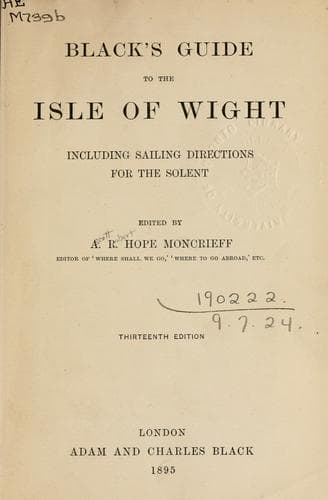
Isle of WightMoncrieff, A. R. Hope (Ascott Robert Hope)
History
Isle of Wight
Moncrieff, A. R. Hope (Ascott Robert Hope)
Isle of Wight (England) -- Description and travel
The parade of Cowes runs on beyond the castle, past gardened villas, to
open out as the Green, a strip of sward set with seats that make the pit
of the open-air theatre for which the Solent is stage in its
yacht-racing season. At the end of this is the point marked by a brick
ivy-clad mansion called Egypt, why so called, one knows not, unless that
the name, occurring elsewhere in England, seems sometimes connected with
gipsy memories. Did one wish to go gipsying, this end of Cowes was once
fairly well adapted for such purposes; but cottages of gentility keep on
spreading along the sea edge.
At Egypt is the bathing beach, from which the sea wall extends onward
towards a bank of wild shrubbery called the “Copse,” a miniature
Undercliff, where, rooted in singularly tenacious mud, an almost
impassable jungle offers scope for the adventurous imagination of youth.
This is skirted by a rough path above the shore, where at morn and eve
may be seen flesh and blood _replicas_ of Frederick Walker’s “Bathers,”
or of Mr Tuke’s “August Blue” scene, exhibited “without the formality of
an apparatus,” as the Oxford man in _Humphrey Clinker_ has it. As for
the bathing-machines further back, a guide-book of his generation states
that “from the manner in which they are constructed, and the position
they occupy, a person may safely commit himself to the bosom of Neptune
at almost any state of the tide.” Yet one may hint to strangers not
desirous of committing themselves to Abraham’s bosom, that the currents
run strong here, and that some parts of the shallow shore deepen
suddenly.
One of the sandiest bathing-places on this shore is at Gurnard’s Bay,
about two miles along, which has an hotel of its own and other
beginnings of a seaside resort. This used to be a landing-place from the
mainland; and here was the site of another Roman villa. The guide-books
of a future generation may have more to say about Gurnard’s Bay; but I
must ask the reader now to turn back to Cowes.
At the back of the town is its Church, built in the time of the
Commonwealth, that did not much foster church architecture; and behind
this stands the manorial mansion of Northwood Park in somewhat gloomy
grounds opened by funereally classical gates. The older parish church is
that of Northwood, some way inland, which itself, in its day, had been
an offshoot of Carisbrooke. Northwood Park hived for a time the foreign
nuns who lately swarmed to other quarters at Ryde. This mansion had long
been looked on by true blue Protestants as a half-way house to Rome,
when it was the home of William George Ward, a prominent name in the
“Oxford Movement” that so much shifted the Anglican establishment’s
centre of gravity. He went over to the Roman Church, and moved to
another house near Totland Bay, where his neighbour Tennyson had warm
words to say over his grave--
Public-domain text, read in full here on John Shaqi.
Reviews
Reviews
No reviews yet
Be the first to share your thoughts on this work.
Elsewhere in the archive
Join the Discussion
Join the discussion
Sign in to leave a comment or review.
Sign InorCreate an account