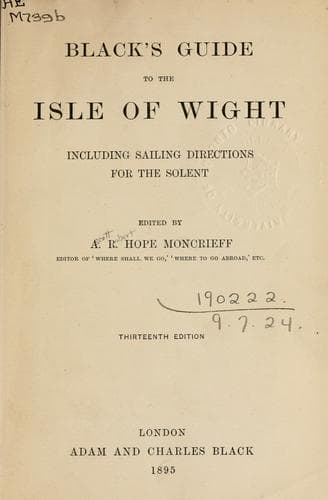
Isle of WightMoncrieff, A. R. Hope (Ascott Robert Hope)
History
Isle of Wight
Moncrieff, A. R. Hope (Ascott Robert Hope)
Isle of Wight (England) -- Description and travel
My friend, the most unworldly of mankind,
Most generous of all ultramontanes, Ward,
How subtle at tierce and quart of mind with mind,
How loyal in the following of thy Lord!
The chief hotels and lodging-houses are found on that part of the parade
east of the “Squadron,” which at one time occupied the Gloucester Hotel.
The crooked main street leads us to the river suburb of Mill Hill, and
to the floating bridge by which the Medina is crossed to East Cowes.
There has been talk of a tunnel here, as under broader channels; but the
amphibious folk of this port are still content with their ferry.
East Cowes, though at one time the more important side, has long been
eclipsed by its western neighbour. It may be described as a suburb of
ambitious roads mounting the wooded background from a rather mean
frontage, so as to bring into curious juxtaposition some characteristics
of Norwood and Rotherhithe. At the seaward end it has a short esplanade
of its own, from which is to be had a fine sunset view over the Solent.
The old fortress on this side has entirely disappeared. The most
interesting house here is Slatwoods, the boyhood’s home of Dr Arnold of
Rugby, his father having been collector of customs at this port. Arnold,
born in a house at West Cowes now marked by a tablet, but brought up on
the other side, always had
[Illustration: OSBORNE HOUSE]
an affection for Slatwoods, and slips of its great willow tree were
transplanted to his successive homes at Laleham, Rugby, and Fox How.
East Cowes is shut in by the grounds of East Cowes Castle and Norris
Castle, mansions of the modern Gothic period, that have had noble
occupants and royal guests. Norris Castle, at the point of the estuary
open to briny breezes from every quarter, was in 1833 tenanted by the
Duchess of Kent, sea-air having been ordered for her daughter’s precious
health. The Princess Victoria made here a collection of sea-weeds which
she presented to her friend Maria da Gloria, the girl-queen of Portugal;
and no doubt in this sequestered nook she was able to go about more
freely than at Bognor or Brighton. She seems to have much enjoyed her
stay on the Solent, probably then taking a fancy to this neighbourhood,
which in later life led to the purchase of Osborne, her favourite
residence when Balmoral was too bleakly bracing. The park begins beyond
the ascent out of East Cowes, extending along the wooded northern shore
towards the small inlet called King’s Quay, that pretends to be a
landing-place of King John, who, after signing Magna Charta, is
dubiously said to have sulked here among the pirates of the Island.
Public-domain text, read in full here on John Shaqi.
Reviews
Reviews
No reviews yet
Be the first to share your thoughts on this work.
Elsewhere in the archive
Join the Discussion
Join the discussion
Sign in to leave a comment or review.
Sign InorCreate an account