Great Britain -- Social conditions -- 19th century -- Fiction
Produced by James Rusk
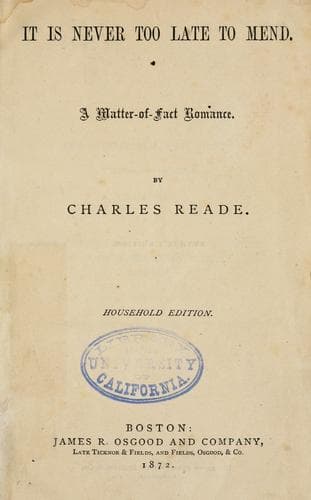
IT IS NEVER TOO LATE TO MEND
By Charles Reade
This attempt at a solid fiction is, with their permission, dedicated to
the President, Fellows, and demies of St. Mary Magdalen College. Oxford,
by a grateful son of that ancient, learned, and most charitable house.
CHAPTER I.
George Fielding cultivated a small farm in Berkshire.
This position is not so enviable as it was. Years ago, the farmers
of England, had they been as intelligent as other traders, could have
purchased the English soil by means of the huge percentage it offered
them.
But now, I grieve to say, a farmer must be as sharp as his neighbors,
or like his neighbors he will break. What do I say? There are soils and
situations where, in spite of intelligence and sobriety, he is almost
sure to break; just as there are shops where the lively, the severe, the
industrious, the lazy, are fractured alike.
This last fact I make mine by perambulating a certain great street every
three months, and observing how name succeeds to name as wave to wave.
Readers hardened by the _Times_ will not perhaps go so far as to weep
over a body of traders for being reduced to the average condition of
all other traders. But the individual trader, who fights for existence
against unfair odds, is to be pitied whether his shop has plate glass
or a barn door to it; and he is the more to be pitied when he is sober,
intelligent, proud, sensitive, and unlucky.
George Fielding was all these, who, a few years ago, assisted by his
brother William, filled “The Grove”--as nasty a little farm as any in
Berkshire.
Discontented as he was, the expression hereinbefore written would have
seemed profane to young Fielding, for a farmer's farm and a sailor's
ship have always something sacred in the sufferer's eyes, though one
sends one to jail, and the other the other to Jones.
It was four hundred acres, all arable, and most of it poor sour land.
George's father had one hundred acres grass with it, but this had been
separated six years ago.
There was not a tree, nor even an old stump to show for this word
“Grove.”
But in the country oral tradition still flourishes.
There had been trees in “The Grove,” only the title had outlived the
timber a few centuries.
On the morning of our tale George Fielding might have been seen near his
own homestead, conversing with the Honorable Frank Winchester.
This gentleman was a character that will be common some day, but was
nearly unique at the date of our story.
He had not an extraordinary intellect, but he had great natural gayety,
and under that he had enormous good sense; his good sense was really
brilliant, he had a sort of universal healthy mind that I can't
understand how people get.
Public-domain text, read in full here on John Shaqi.
Reviews
Reviews
No reviews yet
Be the first to share your thoughts on this work.
Join the Discussion
Join the discussion
Sign in to leave a comment or review.
Sign InorCreate an account